3I/ATLAS: the interstellar comet approaching Earth and what is known about it
Traveling at a speed of nearly 60 kilometers per second, this comet moves through space so quickly that, comparatively speaking, a trip from Arica to Punta Arenas would take just one minute.
This Friday, December 19, comet 3I/ATLAS will reach its closest point to Earth, an astronomical milestone that has sparked worldwide interest. It is the third object of interstellar origin detected by astronomers and discovered by the ATLAS observatory, which is designed to identify asteroids and bodies that could pose a risk of impact to our planet.
Researchers affiliated with the Center for Astrophysics and Associated Technologies (CATA) (ANID Basal Center) and graduate students from the Pontifical Catholic University of Chile (UC), Juan Pablo Carvajal, Baltasar Luco, and Rohan Rahatgaonkar, together with their professor, Dr. Thomas Puzia, Principal Investigator at CATA and professor at UC, have studied the comet based on observations obtained with the Very Large Telescope (VLT) of the European Southern Observatory (ESO), which has allowed them to delve deeper into its composition, dynamics, and interstellar origin.
What is 3I/ATLAS?
The name 3I refers to the fact that it is the third interstellar object to visit our solar system. ATLAS refers to the observatory that discovered it, which was designed to detect asteroids or objects in and outside the solar system that could pose an impact hazard.
The origin of this object comes from a star other than the Sun, traveling for billions of years before entering our Solar System for the first time. According to astronomers, studies of its dynamics, speed, and angle of entry suggest that it was born in our galaxy.
“We can say that it comes from the thick disk of the Milky Way, although at the moment it is not possible to identify a specific star. During its long journey, it may have encountered other stars, and its trajectory could date back to times before the formation of the Solar System,” says Baltasar Luco.
Regarding its size, observations from the Hubble Space Telescope (HST) indicate that the nucleus of 3I/ATLAS has an estimated diameter between 440 meters and 5.6 kilometers. Rohan Rahatgaonkar offers a close comparison to gauge its size.
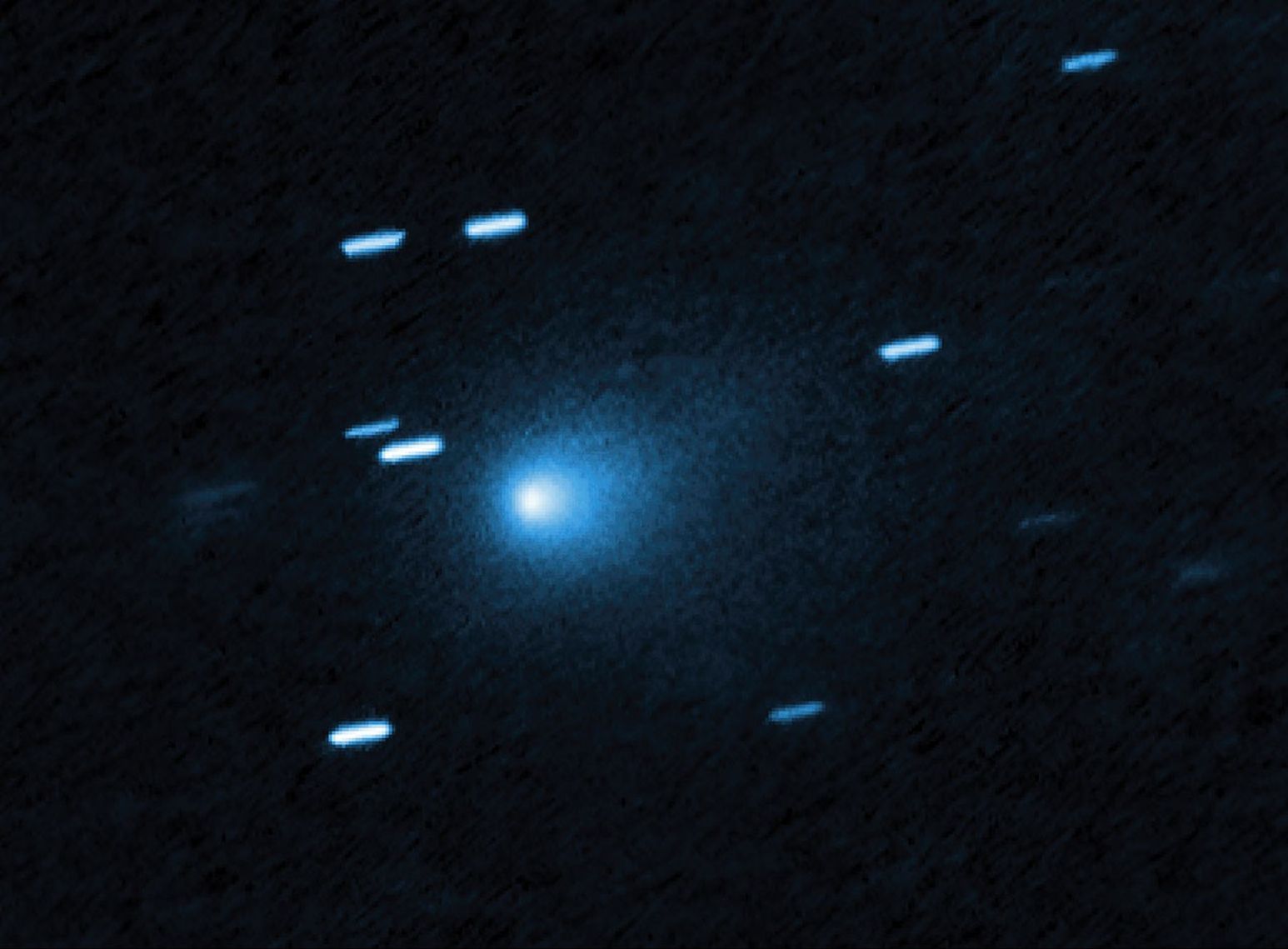
“The Costanera Center tower in Santiago is 300 meters high, so the comet’s nucleus could be approximately 1.5 to 19 times larger than that,” says the astronomer, noting that the coma (the cloud of gas and dust surrounding it) extends far beyond the nucleus, reaching thousands of kilometers.
Another fascinating aspect of this comet is its speed and composition. Traveling at around 60 kilometers per second, it moves so fast that, in the words of Juan Pablo Carvajal, “a trip from Arica to Punta Arenas would take about a minute.”
Its core is composed of ice, dust, and rocky material, but with a particularly interesting chemistry. Observations in which the CATA team participated detected, in its early stages, nickel and iron vapors, as well as carbon-based compounds, in proportions uncommon for comets in the Solar System. Over time and as it has approached the Sun, heating has modified its surface, making its chemistry more similar to that of solar comets, which provides clues about the processing of the exposed material.
The comet’s trajectory has also been constantly monitored. “Its path has not changed abruptly, but it does show variations associated with physical processes typical of comets. As it approaches the Sun, it “sublimates” or ejects material and loses mass, causing a non-gravitational acceleration that changes its trajectory,“ says Baltasar Luco. Even so, he emphasizes that these variations ”are constantly monitored by different telescopes and that its orbit is updated on a recurring basis.”
Why are there no detailed images of this object?
Despite the interest it generates, obtaining detailed images of the comet is not easy. Baltasar Luco explains that this is due to a combination of its small physical size and the great distance at which it is located.
“Its angular size is so small that current telescopes cannot resolve details on its surface,” explains the CATA Research Associate. However, he clarifies that structures such as the coma and tail, which extend for thousands of kilometers, can be captured, especially with wide-field instruments.
These extraordinary characteristics have led to various hypotheses and theories about this interstellar object. However, Juan Pablo Carvajal states that “everything indicates that it is a comet of very primitive composition, which has maintained a highly preserved chemistry since its formation around another star in our galaxy. There is no evidence that it is an artificially created object or extraterrestrial life,” explains the astronomer.
Although the term “closest point” may cause concern, the researchers involved emphasize that 3I/ATLAS will pass at a completely safe distance. Its perigee (closest point to Earth) will occur this Friday, December 19.
Rohan Rahatgaonkar says there is absolutely no danger of collision. “Space is truly immense. Astronomers use a special unit called the Astronomical Unit (AU), which is the average distance between the Earth and the Sun, approximately 150 million kilometers. To put this into perspective, the Moon is 0.0026 AU from Earth, about 384,400 km,” he explains.
He adds that “Comet 3I/ATLAS will be approximately 1.8 AU away, or about 270 million kilometers, at its closest approach on December 19. This is almost twice the distance between the Earth and the Sun, so it poses absolutely no threat of collision.”
The group comments that the comet is too faint to see with the naked eye. However, it can be observed through powerful binoculars or an amateur telescope.
“From Chile, the comet will be in the constellation Leo, near Regulus, which is the brightest star. The best time for observation will be around 3:30 to 4:30 a.m. on December 19 and 20, looking east-northeast when it is at its highest point in the sky,” concludes Rohan Rahatgaokar.
Finally, as part of this astronomical milestone, CATA held a special broadcast on Friday, December 19, in conjunction with BioBioChile. During the broadcast, Dr. Thomas Puzia, Principal Investigator at CATA and professor at the Pontifical Catholic University of Chile, discussed this astronomical milestone, commented on images of the comet, and answered questions from the audience.
Broadcast available on YouTube:
Outstanding news
Recent news
-
 Publicado el: 22/12/2025International study reveals that black holes feed selectively
 -
Publicado el: 20/12/20253I/ATLAS: the interstellar comet approaching Earth and what is known about it
-
 Publicado el: 18/12/2025Ministerial Advisory Committee for Astronomical Observation submits its final report
 -
 Publicado el: 13/12/2025Geminids 2025: facts and how to observe the last meteor shower of the year
 -
 Publicado el: 12/12/2025Call for applications for the CATA Emprende 2026 program now open
Categories list
- Acknowledgments 21
- Astrobiology 6
- AstroCluster 1
- Black holes 20
- Corporativo 58
- Cosmology 5
- Descubrimientos 23
- Disclosure 74
- Exoplanets 14
- Extension 7
- Galaxies 22
- Galaxies formation 6
- Inter y Transdisciplina 4
- Local Universe 17
- Publications 6
- Sin categorizar 34
- Solar System 23
- Stellar formation 8
- Technology 16
- Technology Transfer 18