

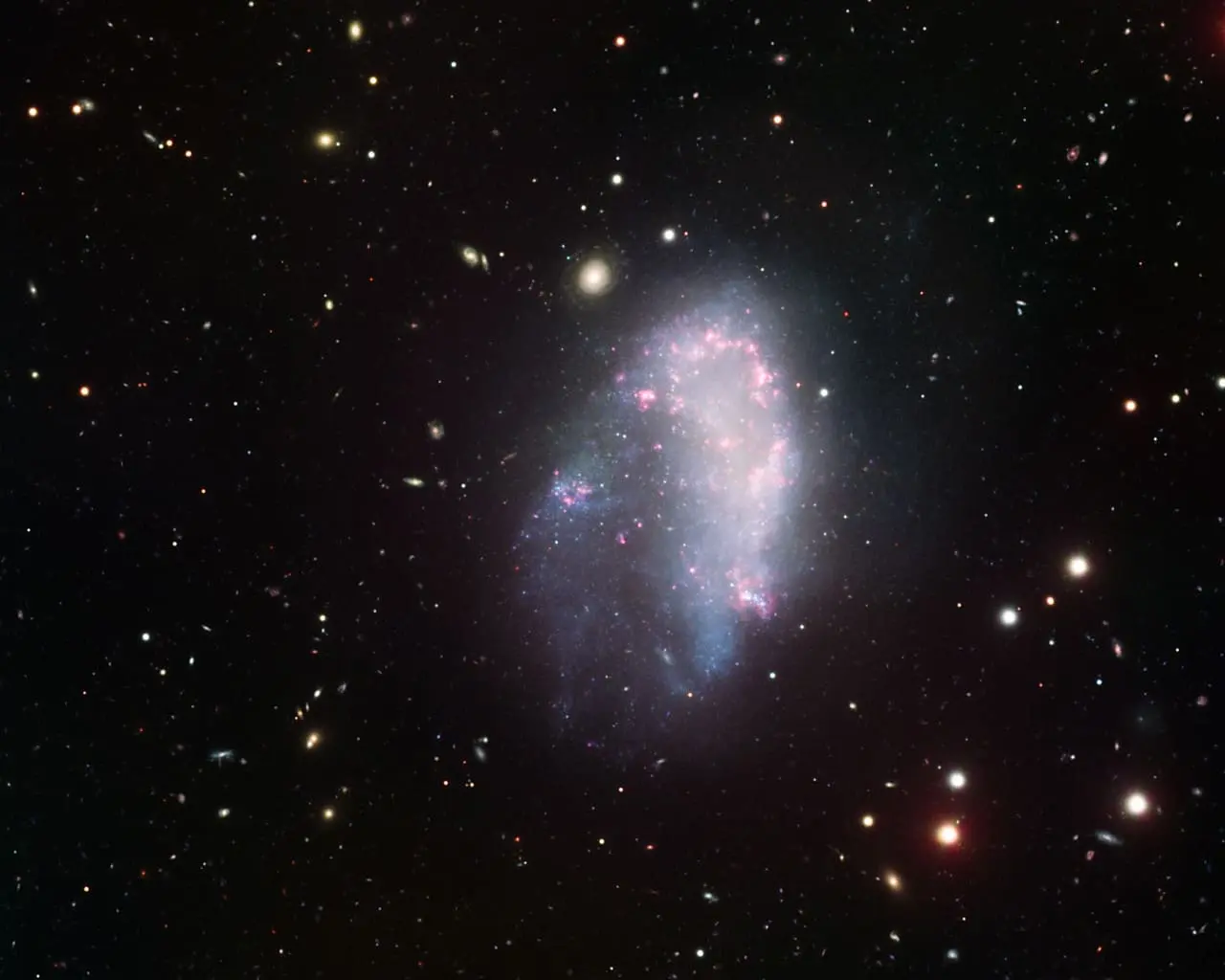
Study led by CATA researchers solves a 30-year-old mystery about a dwarf galaxy
The article, published in Astronomy & Astrophysics, identifies three processes occurring on different time scales that explain the transformation of the dwarf galaxy NGC 1427A.
For more than three decades, the dwarf galaxy NGC 1427A has intrigued the astronomical community. Located in the Fornax Cluster, about 55 million light-years from Earth, it exhibits an irregular morphology, long tails of material, and off-center star-forming regions. Until now, no hypothesis had fully explained the origin of these features.
A study conducted by researchers at the Center for Astrophysics and Associated Technologies – CATA (project financed by ANID) reconstructs the recent history of this galactic object and proposes an explanation that combines three processes occurring on different time scales. The study was led by astronomer Juan Pablo Carvajal, affiliated researcher at CATA and a Ph.D. candidate at the Pontifical Catholic University of Chile (UC), along with Thomas Puzia, principal investigator at CATA and professor at UC, among other researchers.
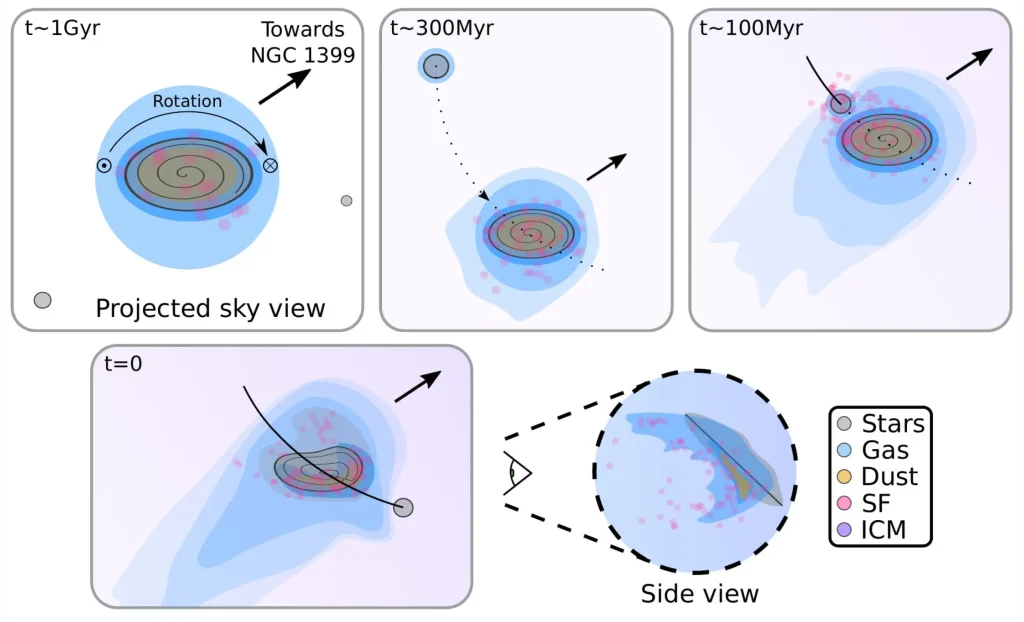
The first of these processes is currently underway: as NGC 1427A moves through the hot gas that fills the cluster, a sort of “wind” is generated that gradually strips away its cold gas. Before that, 30 and 100 million years ago, the galaxy had a close encounter with another dwarf galaxy—likely FCC 229—which disrupted its gas, dust, and stars. And looking even further back, astronomers found evidence that, over the past billion years, other galaxies also disturbed it. The result is an evolutionary history marked by successive interactions.
Over the years, various hypotheses have been proposed, such as a collision between two dwarf galaxies or the effect of the cluster’s gravitational tides. The new study shows that several of these explanations were partially correct, but none was sufficient on its own. In addition, it identified an effect that had not been detected before in this galaxy.
“The possibility that this phenomenon had a significant component along our line of sight had already been raised. However, our study provides, for the first time, compelling evidence that dust has also been stripped away from within the galaxy. This demonstrates that ram-pressure stripping is not only affecting the surrounding material—known as the circumgalactic medium—but also the gas and dust found inside the galaxy, that is, the interstellar medium,” explained Carvajal.
A galaxy in the midst of transition
One of the most striking findings is that NGC 1427A is entering a phase of quenching, during which its ability to form new stars is gradually declining. Between 30 and 40 million years ago, the galaxy experienced an intense episode of star formation, an activity that is currently on the decline.
“Nuestra visión multifase demuestra que las distintas componentes de la galaxia, o sea, estrellas, gas neutro e ionizado y polvo, guardan memoria de eventos diferentes en escalas de tiempo distintas. Las estrellas viejas recuerdan la caída al cúmulo hace miles de millones de años; la cola de hidrógeno neutro registra una perturbación de hace algunos cientos de millones de años; y la formación estelar ultravioleta delata un encuentro cercano hace apenas 30-100 millones de años. Sólo leyendo todos esos relojes a la vez se entiende la transformación completa”, señala Thomas Puzia.
The research also helped resolve two other questions about this object. On the one hand, the stars and gas in the galaxy no longer move in a coordinated manner but instead rotate around different axes—a sign that external forces are acting on the gas. Second, the bright region located to the north—which for years was thought to correspond to a second galaxy in the process of merging with NGC 1427A—is actually a star-forming region belonging to the same galaxy.
To reconstruct this history, the team combined observations from different regions of the electromagnetic spectrum. The main instrument used was MUSE, installed on the European Southern Observatory’s (ESO) Very Large Telescope (VLT), which was used to study the motions of stars and gas, as well as the age and chemical composition of the stars, star formation, and the distribution of dust.
The analysis was supplemented with data from the AstroSat/UVIT space telescope, obtained by Prasanta Kumar Nayak, a postdoctoral researcher at CATA and the University of Chile; measurements of neutral hydrogen from the MeerKAT radio telescope in South Africa; and data on the material from the Spitzer and Herschel space telescopes and the ALMA observatory.
Thanks to ultraviolet light, the team detected an area to the northeast of the galaxy where stars were born—likely following an interaction with FCC 229—and which today shows almost no activity. “The AstroSat/UVIT data revealed an irregular and fragmented star-forming region that extends far beyond what is visible in other observations. This region acts as a ‘fading reminder’ of that episode,” Nayak explained.
A laboratory for understanding dwarf galaxies
Dwarf galaxies are the most abundant in the universe. However, most of those that have been studied in detail are located in the vicinity of the Milky Way and Andromeda. Since the transformation phases they undergo are brief and difficult to observe, the team proposes that NGC 1427A serve as a reference case for studying how the environment of a cluster transforms these systems.
“The idea is to determine whether this preconditioning process is important for dwarf galaxies in general and what effects this transition from the outer regions to the interior of the cluster has. In this case, we are studying it on a single-galaxy scale, but we want to understand what effects this process has on the population as a whole—something that has not been done until now,” concludes Juan Pablo Carvajal.
The study also featured significant participation from national and international scientists, including CATA researchers Rohan Rahatgaonkar and Julio Chanamé, as well as Chilean researcher Matías Blaña from the National Space Center.
Outstanding news
Recent news
-
Publicado el: 19/10/2026Study led by CATA researchers solves a 30-year-old mystery about a dwarf galaxy
-
 Publicado el: 15/10/2026Structures potentially associated with the formation of super-Earths and mini-Neptunes have been detected in compact disks
-
 Publicado el: 09/10/2026From studying the universe to solving industry challenges: CATA’s technology transfer model in Nature Astronomy
-
 Publicado el: 01/10/2026CATA Associate Researcher concludes research stay at the University of São Paulo thanks to a Brazilian fellowship
-
 Publicado el: 29/09/2026Chilean technology aims to improve the accuracy of telescopes studying the origin of the Universe
Categories list
- Acknowledgments 29
- Astrobiology 12
- AstroCluster 1
- Black holes 21
- Corporativo 73
- Cosmology 10
- Descubrimientos 30
- Disclosure 91
- Exoplanets 19
- Extension 14
- Galaxies 29
- Galaxies formation 11
- Inter y Transdisciplina 5
- Local Universe 22
- Publications 9
- Sin categorizar 34
- Solar System 30
- Stellar formation 12
- Technology 33
- Technology Transfer 34


