

Gravitational footprint of a giant black hole discovered in the early universe
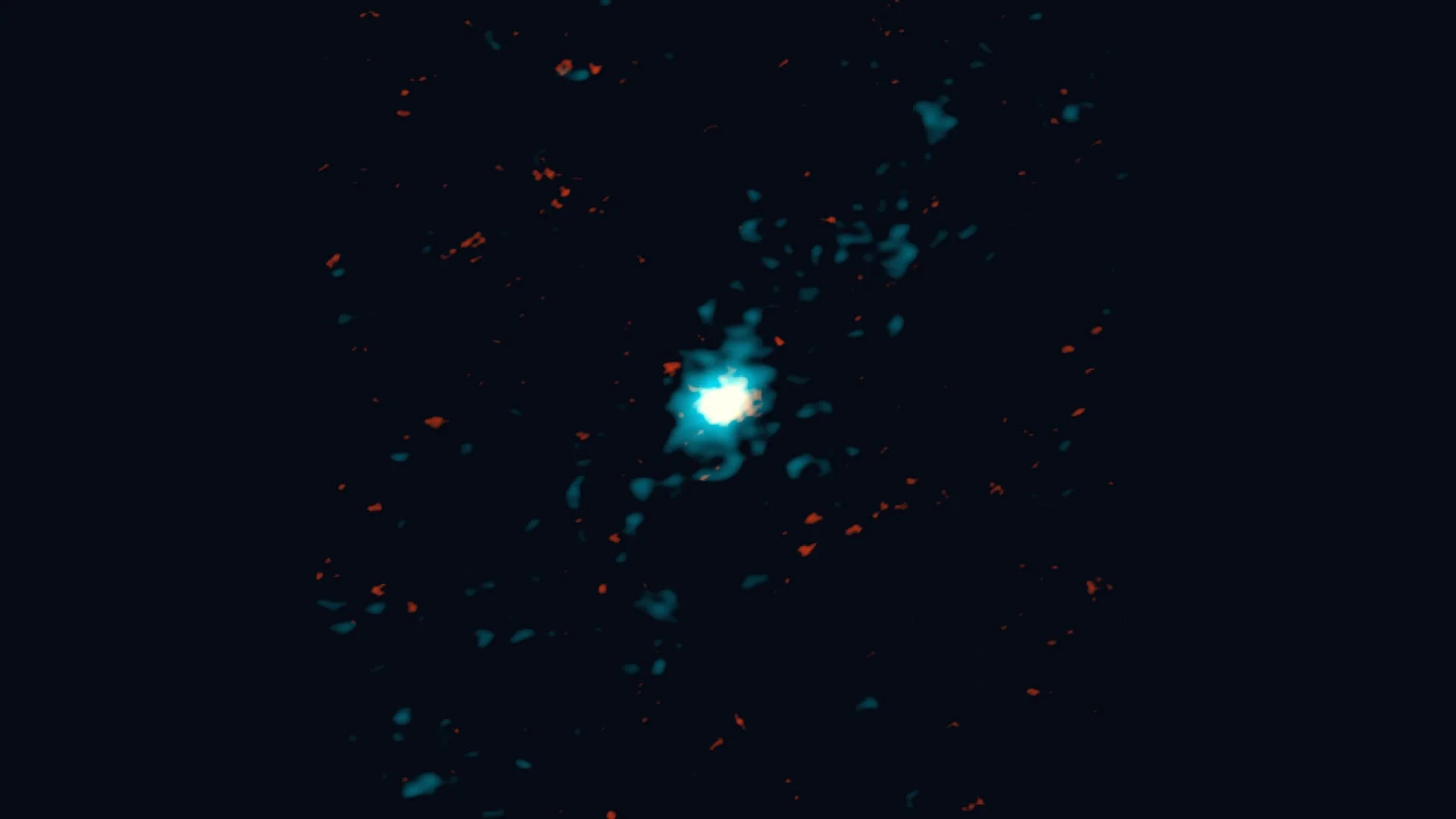
Observations with the ALMA radio telescope made it possible to measure the mass of a supermassive black hole equivalent to 6.5 billion times that of the Sun, in a galaxy whose light has traveled more than 12 billion years to reach Earth. The discovery opens up new possibilities for studying how these giants grew in the early stages of the Universe.
How can we measure the mass of a black hole when it is billions of light-years away? A team of astronomers, made up of researchers from the Center for Astrophysics and Associated Technologies – CATA (project financed by ANID), achieved this using the ALMA (Atacama Large Millimeter/submillimeter Array) radio telescope by studying the motion of gas surrounding the center of a distant galaxy. The results showed that the black hole has a mass equivalent to 6,500 million times that of the Sun, at a time when the universe was only 1,300 million years old.
The study, published in Science Advances, was led by astronomer Mai Liao, Postdoctoral Researcher at CATA affiliated with the National Astronomical Observatories of the Chinese Academy of Sciences and Universidad Diego Portales (UDP), along with Roberto Assef, Deputy Director and Principal Researcher at CATA and professor at UDP.
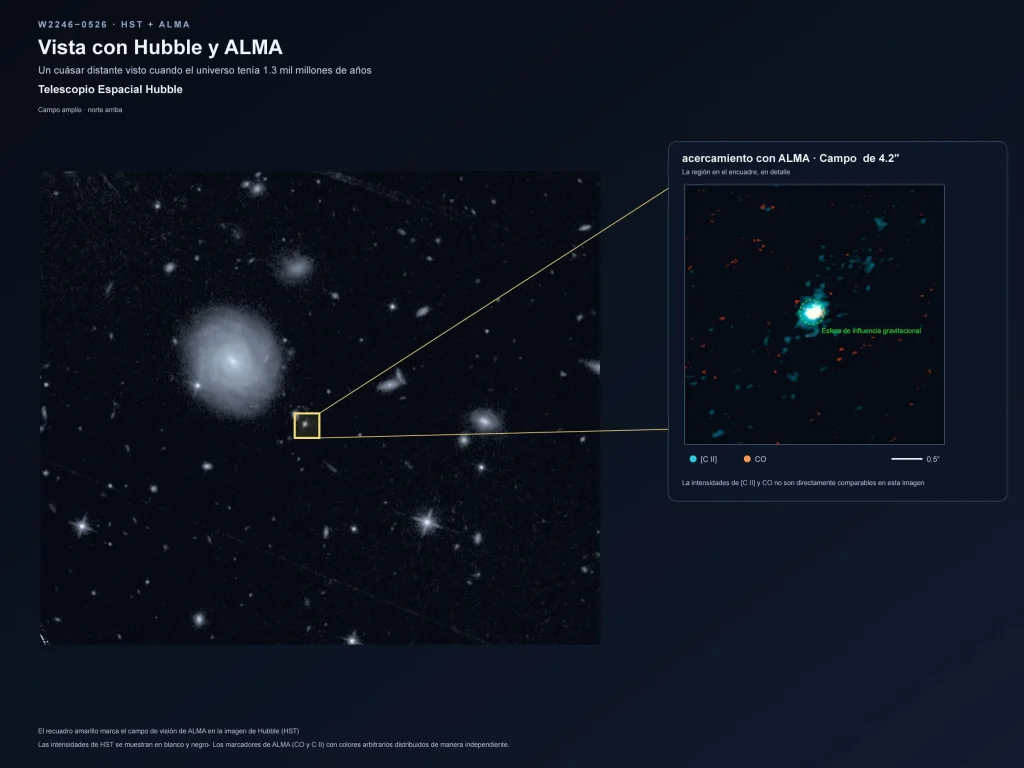
The object under study is W2246-0526, an extremely luminous, dust-shrouded galaxy whose brightness is fueled by an active supermassive black hole, known as a quasar. Its light has been stretched by the expansion of the universe to a wavelength 5.6 times greater than the original. This phenomenon, called redshift, allows us to determine its distance and observe the galaxy as it was during a very early stage in the history of the cosmos.
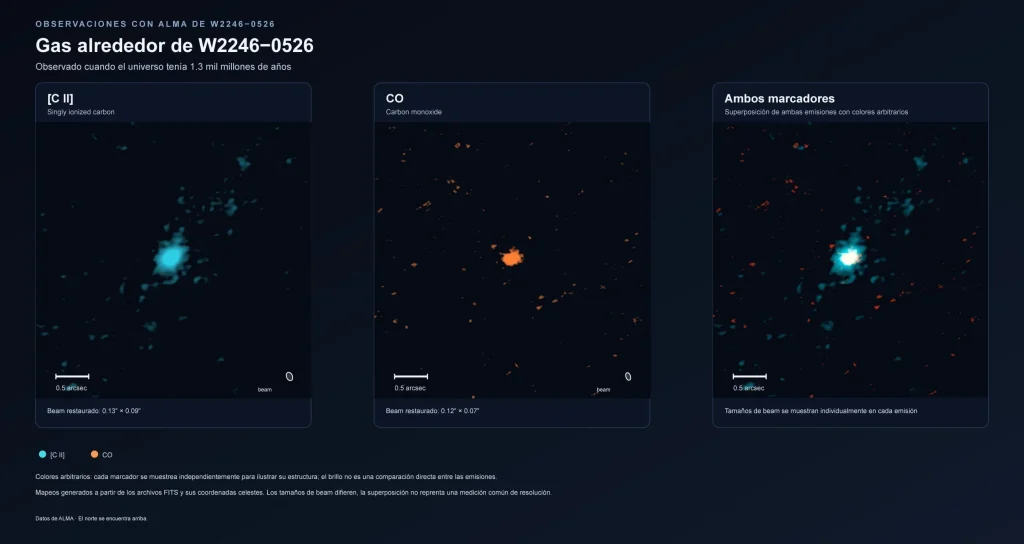
To determine the black hole’s mass, the team analyzed how gas moves near the center of the galaxy, using emissions of ionized carbon and carbon monoxide detected by ALMA. The observations allowed them to identify structures approximately 700 light-years in size and to detect that the gas’s velocity increases significantly as it approaches the center—a sign of the black hole’s gravitational influence.
This result also made it possible to study the so-called sphere of influence of the black hole—the region in which its gravity dominates that of the host galaxy. This is the first dynamic measurement of the mass of a black hole in a galaxy that is not significantly amplified by the gravity of another object, at a redshift greater than 2, in which it was possible to spatially resolve this region.
“ALMA allows us to study in detail the movements of gas near the black hole and to distinguish the various dynamic components of the entire galaxy, including those caused by the black hole’s gravity,” said Roberto Assef.
The ability to perform this type of measurement is particularly significant, since the mass of black holes in distant quasars is typically estimated indirectly, based on the light they emit and the width of their spectral lines. In contrast, studying the motion of the gas allows us to measure how it responds directly to the black hole’s gravity and, thereby, to test the methods used to estimate its mass in the early Universe.
The researchers suggest that the large amount of dust surrounding W2246-0526 could be key to explaining this result. This material would act as a shield against some of the quasar’s intense radiation, allowing the carbon and other elements present in the gas to survive closer to the black hole and be detected by ALMA. Therefore, galaxies with quasars heavily obscured by dust could become particularly useful targets for studying the masses of black holes in the early Universe.
“By analyzing the gas movements near the center, we can observe how the black hole’s gravity leaves its mark on the surrounding environment. This allows us to dynamically measure its mass at a time when the universe was just 1.3 billion years old and compare it with estimates based on the quasar’s light,” explains Mai Liao.
This discovery opens up new possibilities for studying the evolution of supermassive black holes and their relationship with the galaxies that host them. Directly measuring their mass at such early stages allows us to test current estimates and advance our understanding of how these objects came to reach extraordinary sizes when the cosmos was still young.
The study also included CATA Researchers Manuel Aravena of Universidad Diego Portales, and Jorge González-López of the Pontificia Universidad Católica de Chile.
Outstanding news
Recent news
-
Publicado el: 23/11/2026Gravitational footprint of a giant black hole discovered in the early universe
-
 Publicado el: 16/11/2026Discovery of the first lunar meteorite in South America confirmed: it was found in the Atacama Desert
-
 Publicado el: 16/11/2026Leonids 2026: how to watch one of November’s most anticipated meteor showers from Chile
-
 Publicado el: 12/11/2026CATA researchers take top spots in “Thesis in Three Minutes” competitions
-
 Publicado el: 05/11/2026Juan Espinoza-Retamal wins the first CATA PhD Award for his research on planetary systems
Categories list
- Acknowledgments 32
- Astrobiology 12
- AstroCluster 1
- Black holes 22
- Corporativo 74
- Cosmology 10
- Descubrimientos 32
- Disclosure 92
- Exoplanets 20
- Extension 14
- Galaxies 32
- Galaxies formation 12
- Inter y Transdisciplina 5
- Local Universe 22
- Publications 9
- Sin categorizar 34
- Solar System 32
- Stellar formation 14
- Technology 34
- Technology Transfer 34


