

4MOST launches its five-year scientific program, with CATA researchers participating in two major astronomy projects
The instrument installed at the Paranal Observatory is embarking on a new phase of observations that will make it possible to study millions of celestial objects. Highlights of this program include the CHANCES and CHANGES projects, led from Chile with the participation of scientists from CATA.
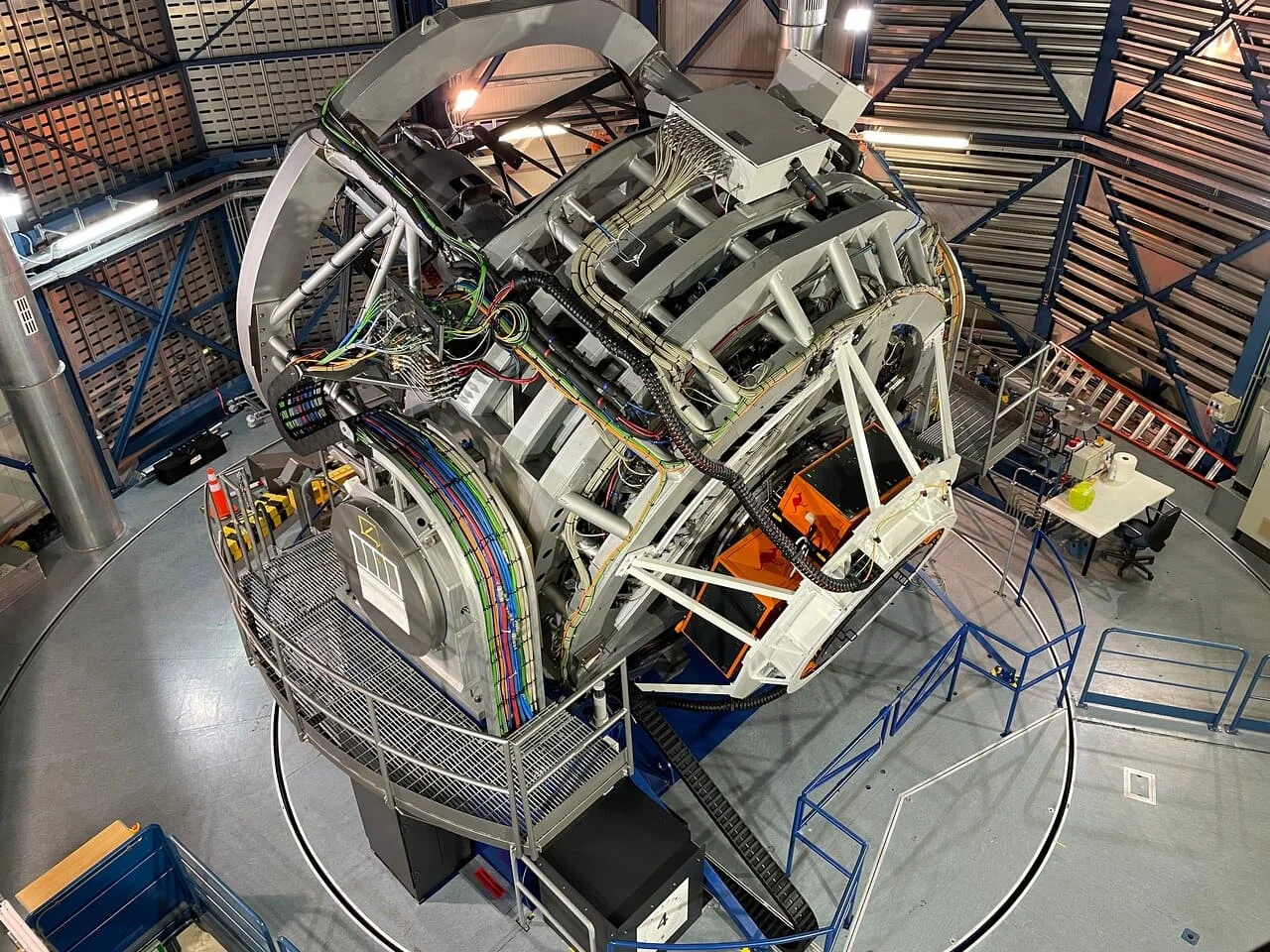
After achieving first light in October 2025 and completing a period of testing and scientific verification, the 4MOST (4-meter Multi-Object Spectroscopic Telescope) instrument, installed on the VISTA telescope at the European Southern Observatory’s (ESO) Paranal Observatory, will begin its main scientific observation program.
Led by the Leibniz Institute for Astrophysics in Potsdam (AIP, Germany), in collaboration with ESO, 4MOST expects to obtain more than 50 million spectra of celestial objects over the next five years through 25 simultaneous scientific projects. The observations will range from stars in the Milky Way to distant galaxies and supermassive black holes. Capable of observing about 2,400 objects at once using thousands of optical fibers, the instrument analyzes their light to determine properties such as chemical composition and motion. During its verification campaigns, it has already obtained more than 800,000 scientifically useful spectra.
Notable among these programs are the CHileAN Cluster Galaxy Evolution Survey (CHANCES) and the CHilean Active Galactic Nuclei and Galaxy Evolution Survey (CHANGES), two initiatives led from Chile with significant participation from the Center for Astrophysics and Associated Technologies – CATA (project financed by ANID).
CHANCES: studying how the environment shapes galaxies
The CHANCES project, led by Yara Jaffé, Associate Researcher at CATA, professor at the Universidad Técnica Fedérico Santa María (UTFSM), and deputy director of the Millennium Galaxies Research Center (MINGAL), together with Christopher Haines of the Universidad de Atacama, seeks to understand how the environments in which galaxies are found influence their formation and evolution.
Using spectroscopic observations of approximately 500,000 galaxies, the program will study about 150 galaxy clusters, investigating how these large structures alter the characteristics of galaxies and affect their ability to form new stars.
After seven years of preparation, CHANCES is beginning its regular observation program, building on the encouraging results obtained during the scientific verification phase conducted in February 2026. According to Yara Jaffé, these data have made it possible to evaluate the program’s efficiency and to look forward with optimism to the development of future observations. “Our priority at this stage is to observe the Shapley Supercluster, which contains dozens of clusters and groups of galaxies intertwined with cosmic filaments,” the researcher noted.
This group of structures provides a particularly relevant setting for studying how galaxies move through the so-called cosmic web, which consists of large concentrations of matter connected by extensive filaments. As they pass through these environments, galaxies may undergo structural changes and lose the gas needed to form new stars.
“We hope to understand how galaxies evolve as they travel through the Great Cosmic Web,” added Jaffé, who also noted that one of the main challenges will be coordinating observations with the various scientific teams that share the instrument.
For her part, Antonela Monachesi, Principal Researcher at CATA and professor at the Universidad de La Serena (ULS), emphasized that CHANCES represents an important opportunity to strengthen the country’s scientific capabilities, both through the leadership of its researchers and the participation of students and young astronomers at various stages of the project. “CHANCES offers a work plan spanning several years, which will enable the development of numerous theses and the training of a new generation of astronomers with the experience and networks needed to lead future projects from Chile,” Monachesi said.
The researcher also noted that the program will make it possible to study the outer regions of galaxy clusters, where galaxies may begin to transform even before they join these large structures, opening up new possibilities for understanding the processes that determine their evolution.
CHANGES: A new window into the growth of supermassive black holes
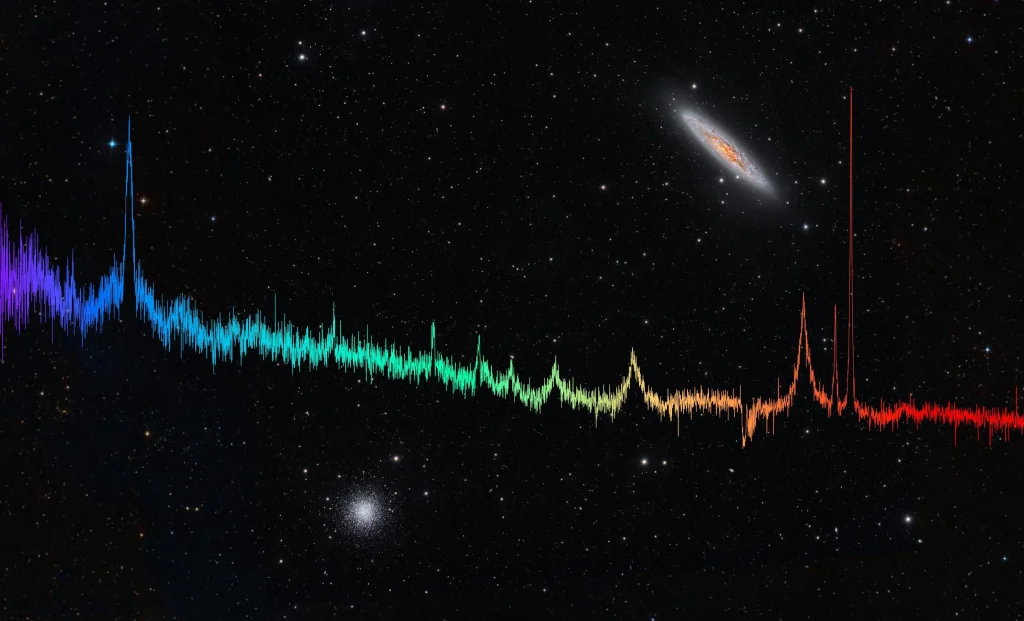
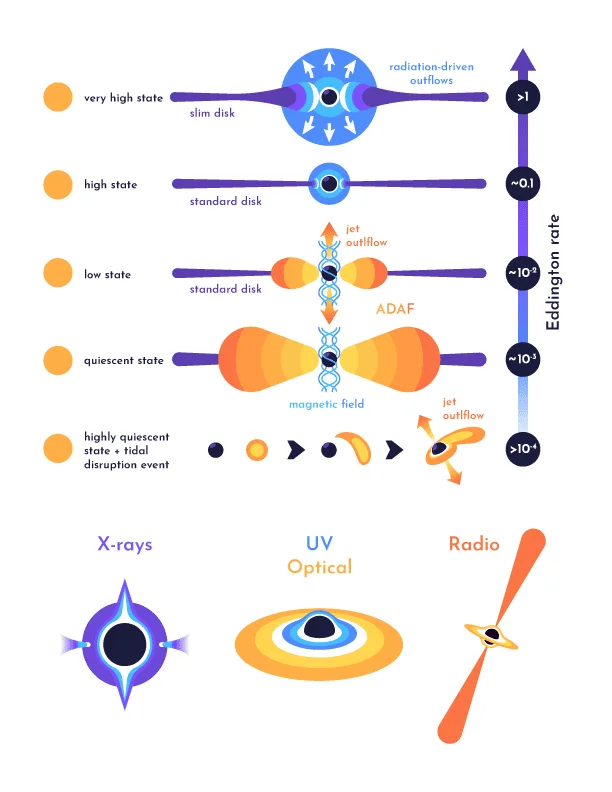
The CHANGES project, led by Franz Bauer, Associate Researcher at CATA and professor at the Universidad de Tarapacá (UTA), together with Paulina Lira of the Universidad de Chile, will use approximately 7.5% of 4MOST’s total observation time to study up to 1.2 million active galactic nuclei (AGNs), that is, the central regions of galaxies where supermassive black holes grow by accreting gas from their surroundings.
One of its main objectives will be to understand how these black holes grow, especially those that are less active and therefore more difficult to detect. The project will also investigate the relationship between the properties of these objects and the characteristics of the galaxies that host them.
Ezequiel Treister, Principal Researcher at CATA and professor at UTA, explained that the start of the observations will allow researchers to move from identifying potential objects of study to their scientific characterization. “For CHANGES, this means moving from the candidate catalogs we’ve compiled using data from other telescopes to obtaining spectra that reveal the nature of these objects, how far away they are, and what is happening in the vicinity of their black holes,” he said.
To achieve these objectives, CHANGES will combine spectroscopic observations from 4MOST with data from the Vera C. Rubin Observatory, located at Cerro Pachón, whose observation program—the Legacy Survey of Space and Time (LSST)—began in June 2026. While Rubin will make it possible to monitor changes in the brightness of millions of objects over time, 4MOST will provide spectroscopic data to determine their distances, study the properties of their black holes, and characterize the galaxies that contain them.
“Rubin will tell us which objects vary and how they do so, while 4MOST will provide us with the spectrum of each object, which will reveal its distance, the mass of its black hole, the velocity of the gas surrounding it, and the properties of the stars in the host galaxy,” explains Treister.
The astronomer also notes that CHANGES will seek to identify phenomena such as black holes whose activity changes drastically over relatively short periods, as well as tidal disruption events, which occur when a star passes too close to a black hole and is torn apart by its intense gravity.
These observations will make it possible to investigate how black holes feed, how long their active periods last, and how they may influence the evolution of galaxies. Quasars from the early Universe—extremely luminous objects—will also be studied, providing deeper insights into the history of the first supermassive black holes.
CATA’s role in 4MOST
CATA researchers have contributed to the planning of CHANCES and CHANGES, the design of observation strategies, and the initial testing of the instrument. During this new phase, their work will focus on the scientific analysis of the data and on training new generations of astronomers.
In addition to Yara Jaffé and Antonela Monachesi, CHANCES also includes CATA Associate Researchers Cristóbal Sifón (Universidad Católica de Valparaíso) and Ricardo Demarco (Universidad Andrés Bello), Postdoctoral Researchers Ciria Lima-Dias and Hugo Méndez; and Ph.D. student Simón Véliz (all from Universidad de La Serena).
In addition to Franz Bauer and Ezequiel Treister, the CHANGES team includes Principal Researchers Roberto Assef (Universidad Diego Portales) and Felipe Barrientos (Universidad Católica); Associate Researcher Timo Anguita (Universidad Andrés Bello); and Assistant Researcher Chiara Mazzucchelli (Universidad Diego Portales).
The launch of the 4MOST scientific program marks a new era for international astronomy, with the goal of transforming the data collected from observatories in Chile into new insights into the evolution of galaxies, the growth of supermassive black holes, and the history of the universe.
1. 4MOST first-light field, showing the objects observed by the fibers. Credit: AIP/Background: Harshwardhan Pathak/Telescope Live

2. First-light sky showing the spectrum of a distant galaxy with an active nucleus (an AGN—precisely the type of object studied by CHANGES). Credit: AIP/R. de Jong, CRAL/J.-K. Krogager
3. Diagram of the types of growing black holes that CHANGES will study. Credit: J. Utreras / F. Bauer (CATA)
Outstanding news
Recent news
-
 Publicado el: 26/11/2026Researcher Laura Pérez reaches a new milestone for Chilean astronomy
-
Publicado el: 26/11/20264MOST launches its five-year scientific program, with CATA researchers participating in two major astronomy projects
-
 Publicado el: 25/11/2026Distance of the candidate for the farthest “little red dot” in the Universe confirmed
-
 Publicado el: 23/11/2026Gravitational footprint of a giant black hole discovered in the early universe
-
 Publicado el: 16/11/2026Discovery of the first lunar meteorite in South America confirmed: it was found in the Atacama Desert
Categories list
- Acknowledgments 33
- Astrobiology 12
- AstroCluster 1
- Black holes 24
- Corporativo 74
- Cosmology 10
- Descubrimientos 33
- Disclosure 92
- Exoplanets 20
- Extension 14
- Galaxies 34
- Galaxies formation 12
- Inter y Transdisciplina 5
- Local Universe 22
- Publications 10
- Sin categorizar 34
- Solar System 32
- Stellar formation 14
- Technology 34
- Technology Transfer 34


