

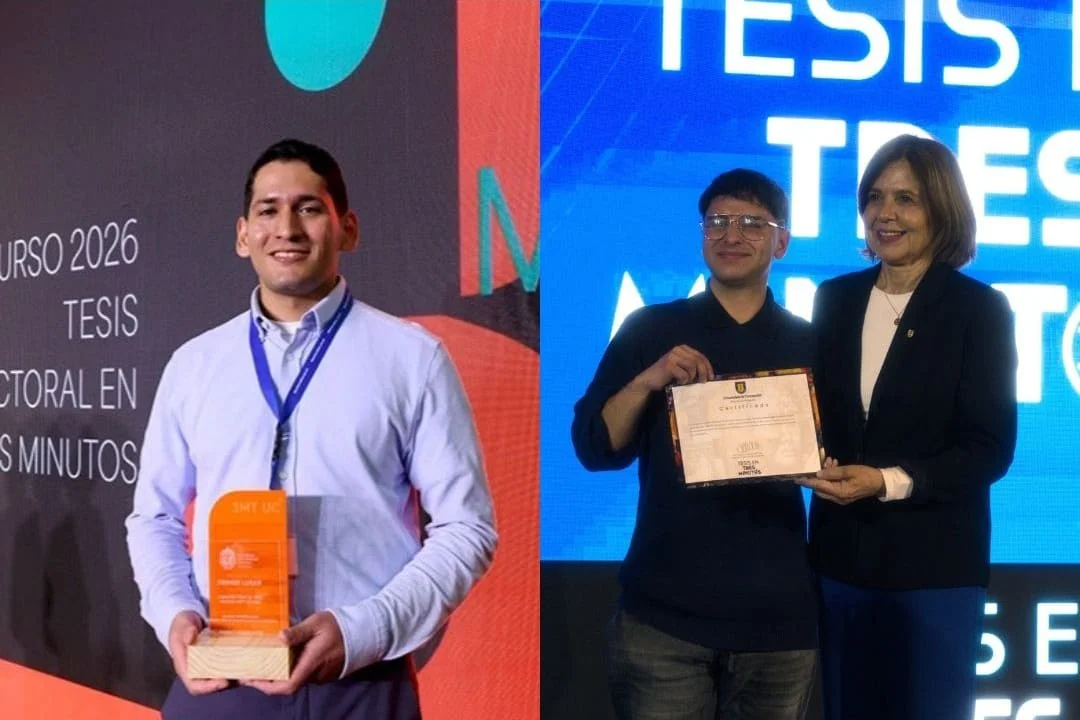
CATA researchers take top spots in “Thesis in Three Minutes” competitions
Juan Pablo Carvajal González and Giulianni Bernal Mesina were recognized for their ability to communicate research on galaxy evolution and star formation to non-specialist audiences in competitions organized by the Pontificia Universidad Católica de Chile and Universidad de Concepción, respectively.
Two affiliated researchers at the Center for Astrophysics and Associated Technologies – CATA (project financed by ANID) took first place in their respective categories in the “Thesis in Three Minutes” competitions, organized by the Pontificia Universidad Católica de Chile (UC) and the Universidad de Concepción (UdeC). They are Juan Pablo Carvajal González, winner in the doctoral category at UC, and Giulianni Bernal Mesina, who took first place in the master’s category at UdeC.
Both competitions aim to strengthen graduate students’ scientific communication skills by challenging them to explain their research in no more than three minutes, using clear and accessible language for non-specialist audiences. The awards highlight both the researchers’ academic work and their ability to make astronomical knowledge accessible to the public.
Juan Pablo Carvajal González: reconstructing the history of galaxies
Juan Pablo Carvajal González, CATA affiliated researcher and UC doctoral student, took first place in the UC “Thesis in Three Minutes” competition, emerging victorious among 45 contestants from 17 doctoral programs.
Under the supervision of Thomas Puzia, Principal Researcher at CATA and professor at the UC Institute of Astrophysics, he presented “How Small Galaxies Reveal Cosmic History,” a talk on the transformations that dwarf galaxies undergo upon entering the Fornax Cluster, a group of nearby galaxies.
His research seeks to understand how gravitational interactions with other galaxies and the presence of hot gas in the cluster can alter or deplete the material they need to continue forming new stars. For these studies, he uses observations from the MUSE instrument, installed on the Very Large Telescope (VLT) in northern Chile. By analyzing the composition, motion, and ages of the stars, along with the properties of the gas and dust, he seeks to reconstruct how these galaxies have evolved over time.
His current research focuses on a sample of 38 dwarf galaxies in the Fornax Cluster. To explain these phenomena during the competition, Juan Pablo compared the galaxies to archaeological sites, where stars and gas preserve clues that allow us to reconstruct their past.
The researcher also acknowledged that preparing a presentation lasting just three minutes posed a significant personal challenge, especially since he had to present his work in English to a non-specialist audience. “It was very rewarding to have that effort recognized, but it also showed me that, with consistent work, I can improve a skill that I find difficult and move toward a more comprehensive scientific education,” he added.
For his part, Thomas Puzia praised the recognition and highlighted the astronomer’s ability to synthesize complex research. “Condensing that into three minutes and presenting it to a non-specialist jury, without losing the essentials, is very difficult. His idea of viewing galaxies as an archaeological site elegantly solved that challenge and reflects something that, to me, is key: you can only explain something with that clarity if you truly understand it,” he said.
Thanks to his first-place finish, Juan Pablo will represent UC in the Universitas 21 “Thesis in Three Minutes” international competition, which brings together representatives from universities around the world.
Giulianni Bernal Mesina: understanding how massive stars form
For his part, Giulianni Bernal Mesina, affiliated researcher at CATA and a master’s student in astronomy at the Universidad de Concepción (UdeC), won first place in his category in the UdeC 2026 “Thesis in Three Minutes” competition.
His research, titled “Understanding the Kinematics of the Vela C Massive Molecular Cloud,” is being conducted under the supervision of Amelia Stutz, Principal Researcher at CATA and professor in the Department of Astronomy at the UdeC.
This study aims to understand how gas moves within Vela C, a vast molecular cloud in our galaxy where new stars are born. In particular, it examines the role played by filaments—elongated structures of gas that may transport material to the densest regions of these clouds and contribute to the formation of massive stars.
Using observations obtained with the APEX radio telescope, located in northern Chile, the researcher analyzes the movement of gas in different regions of the cloud based on signals emitted by various forms of carbon monoxide. His preliminary results show patterns in the movement of the gas that could be associated with processes of material accumulation in denser regions.
“This research will help us better understand how stars form in our galaxy and, in particular, how filaments may contribute to the formation of massive stars by transporting material to the regions where they are born,” Bernal explained.
Regarding his education, Giulianni particularly appreciated the guidance of his supervisor, Amelia Stutz, who has helped him develop his critical thinking skills and autonomy as a researcher. He also highlighted the support provided by CATA, which has allowed him to balance his academic studies with participation in conferences and science outreach activities.
The Principal Researcher at CATA highlighted the young researcher’s effort and commitment, as well as the importance of recognizing new generations of scientists. “I really appreciate that they’re recognizing Giulianni’s work; he has worked very hard to advance his research. This kind of recognition gives him the motivation to continue and improve. It is essential to recognize, nurture, and foster our young talent at the UdeC,” said Amelia Stutz.
The importance of communicating science
For both astronomers, the recognition also represents a step forward in their communication skills and their work to spread knowledge. “Communication is a fundamental part of doing science. In addition to sharing our findings with other specialists, we have a responsibility to bring them to the public: to inspire, educate, and build knowledge that can open up new possibilities for development, even in the long term,” Carvajal said.
For his part, Bernal, who has been involved in science outreach since his undergraduate days, agreed on its significance. “This recognition has great emotional value for me, since I’ve participated in activities such as exhibiting at fairs and giving talks. It’s something I’m truly passionate about, and being recognized for the skills I’ve acquired by doing what I love is a significant personal achievement,” he said.
Although their work addresses different phenomena, both share the challenge of transforming specialized knowledge into accessible narratives capable of sparking the public’s curiosity and interest in astronomy. Their achievements reflect CATA’s commitment to training new generations of specialists and communicating scientific knowledge to society.
Outstanding news
Recent news
-
Publicado el: 12/11/2026CATA researchers take top spots in “Thesis in Three Minutes” competitions
-
 Publicado el: 05/11/2026Juan Espinoza-Retamal wins the first CATA PhD Award for his research on planetary systems
-
 Publicado el: 02/11/2026ANID renews CATA’s basal finance for five years and envisions a new phase of scientific and technological development
-
 Publicado el: 19/10/2026CATA will contribute to data processing for a major international astronomy project
-
 Publicado el: 19/10/2026Study led by CATA researchers solves a 30-year-old mystery about a dwarf galaxy
Categories list
- Acknowledgments 32
- Astrobiology 12
- AstroCluster 1
- Black holes 21
- Corporativo 74
- Cosmology 10
- Descubrimientos 30
- Disclosure 91
- Exoplanets 20
- Extension 14
- Galaxies 31
- Galaxies formation 12
- Inter y Transdisciplina 5
- Local Universe 22
- Publications 9
- Sin categorizar 34
- Solar System 30
- Stellar formation 14
- Technology 34
- Technology Transfer 34


