

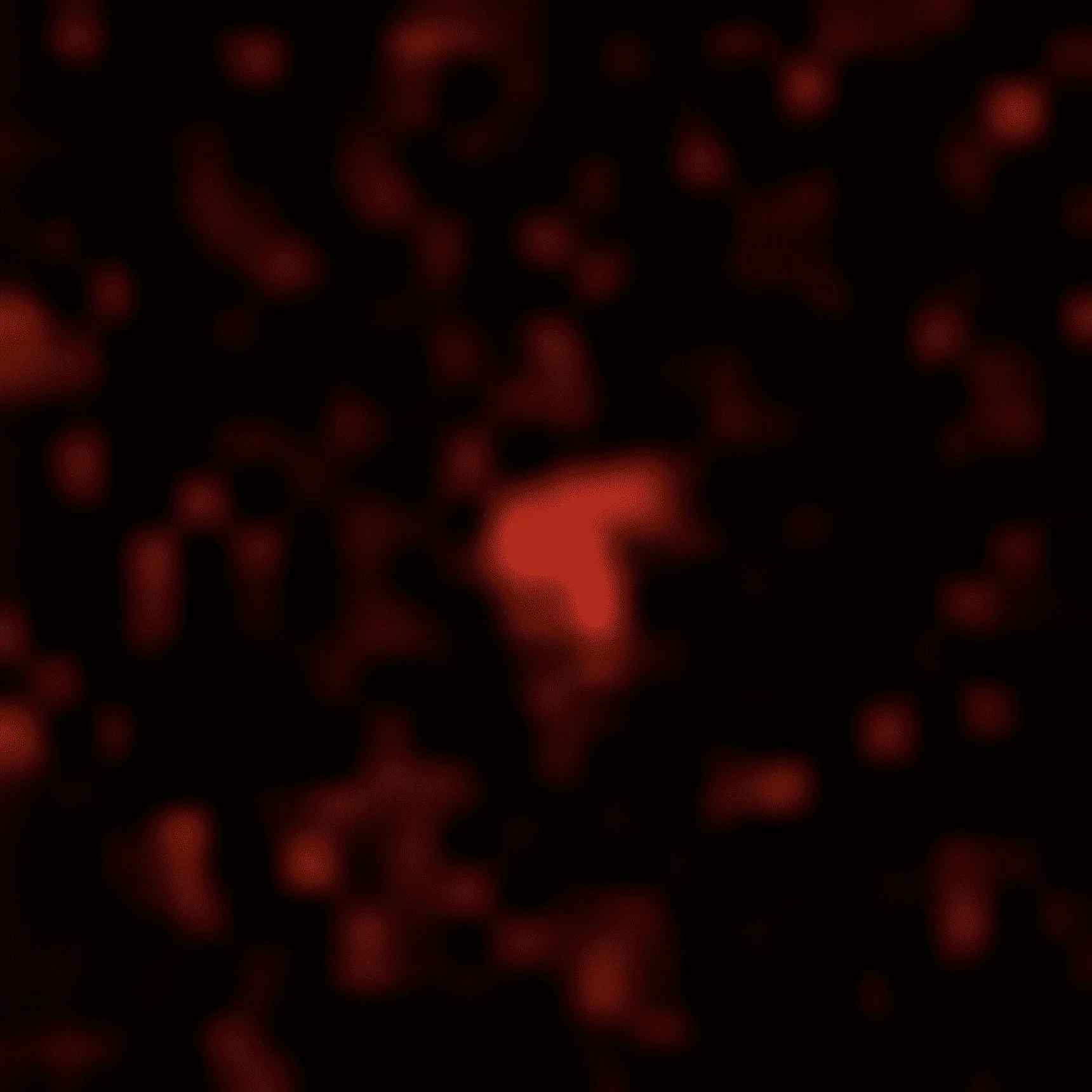
Distance of the candidate for the farthest “little red dot” in the Universe confirmed
Using observations from the James Webb Space Telescope, an international team of researchers—including Chilean astronomers from CATA—confirmed the distance to an enigmatic object that existed when the universe was just 450 million years old.
An international team of astronomers, including scientists from Chile’s Center for Astrophysics and Associated Technologies -CATA (project financied by ANID) has confirmed the distance to CW-LRD-z10, considered the most distant candidate for the Little Red Dot (LRD) identified to date. The discovery, led by Japanese astronomer Takumi Tanaka as part of the EMBER observation program and published in the scientific journal *The Astrophysical Journal Letters*, could provide insights into the early stages of supermassive black hole formation.
LRDs are extremely compact, reddish objects discovered through observations by NASA’s James Webb Space Telescope (JWST). Although their nature is still being investigated, one of the leading hypotheses suggests that they may harbor young black holes that are rapidly accreting matter, representing one of the earliest stages in the growth of these cosmic giants.
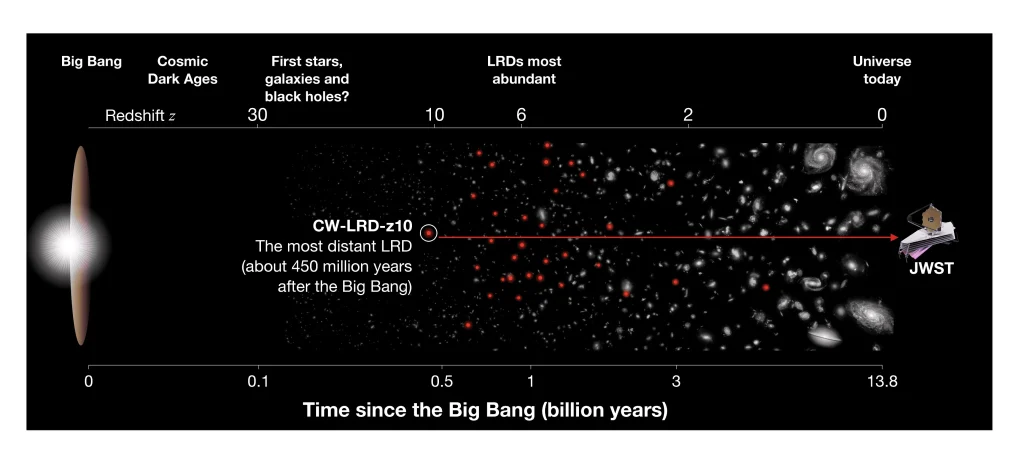
The research, which included the participation of Chileans Ezequiel Treister—Principal Researcher at CATA and professor at the Institute for Advanced Research at the Universidad de Tarapacá (UTA)—and Manuel Aravena—Associate Researcher at CATA and professor at the Universidad Diego Portales (UDP)—established that CW-LRD-z10 exhibits a redshift of 10.36, which means that its light was emitted when the universe was approximately 450 million years old—3% of its current age.
“Using the spectrum obtained with the JWST, we were able to directly measure its distance based on its redshift,” explains Ezequiel Treister. “The significance of this result lies in the fact that it allows us to observe a stage in cosmic history that, until now, had been studied only through theoretical models.”
A new window into the origins of the first black holes
Supermassive black holes exist at the center of most galaxies. However, there are still significant questions about how they formed and managed to grow so rapidly during the early stages of the universe. In this scenario, LRDs could represent an early phase of that process. “These could be precisely the first stage of that growth: young black holes accreting material at a very high rate, likely enveloped in a dense layer of gas,” notes Treister.
In that sense, identifying an object with these characteristics when the universe was only 450 million years old represents an opportunity to understand when its first “seeds” began to form and under what conditions they were able to evolve into supermassive black holes.
To arrive at these results, the scientific team combined observations made with various JWST instruments. Using images obtained with NIRCam, its near-infrared camera, and MIRI, its mid-infrared instrument, the researchers identified CW-LRD-z10 as an LRD candidate as part of the COSMOS-Web observation program.
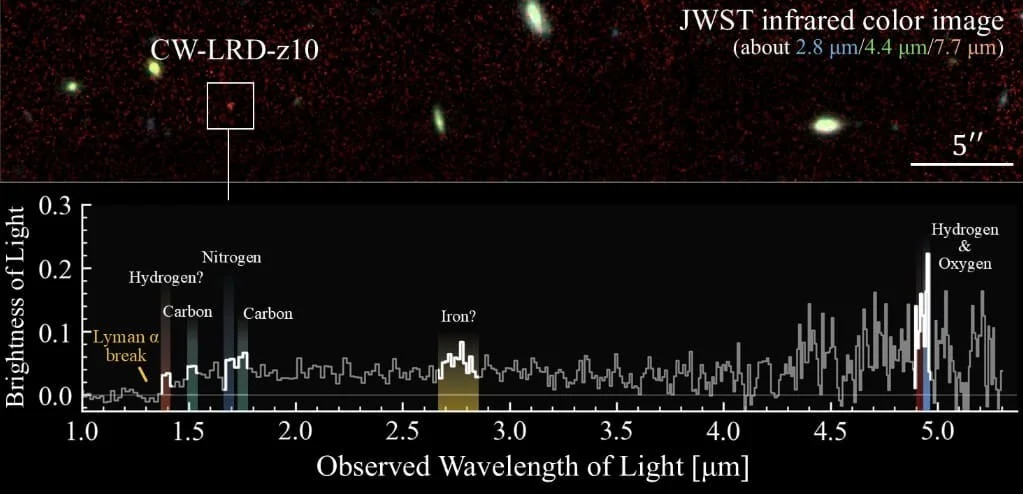
The definitive result came this time through the EMBER program, where researchers used the NIRSpec spectrograph to analyze the light from the object in detail and determine its distance more precisely. “With NIRSpec, we were able to measure its spectrum based on the drop in light caused by the absorption of neutral hydrogen, which confirms that its light was emitted when the universe was 3% of its current age,” explains Manuel Aravena.
Signs that could reveal the nature of the object
In addition to confirming its distance, the researchers identified possible emissions of various chemical elements, including carbon, oxygen, and iron, which could provide information about the physical conditions of the object and the processes that occurred during the early stages of the universe.
These associated signals could be related to the presence of high-energy radiation, which is produced in the vicinity of a growing black hole. Furthermore, a possible emission of iron exhibits characteristics similar to those observed in quasars, which are extremely luminous objects whose activity is linked to supermassive black holes.
These data provide insights into the formation of the early Universe. “Carbon, oxygen, and iron were not formed during the Big Bang; they are created inside stars and dispersed when those stars explode as supernovae. Finding them at this stage implies that the chemical enrichment must have occurred very rapidly,” Treister notes.
Even so, scientists suggest that these detections are still tentative and that the current data do not allow us to completely rule out the possibility that some of the observed radiation stems from star-forming processes. Therefore, further observations will be needed to determine with greater certainty whether CW-LRD-z10 actually hosts an active black hole.
Upcoming observations to solve the mystery
In the next stages, the team plans to conduct further observations using the James Webb Space Telescope’s MIRI instrument, analyzing the object’s emission at longer wavelengths and studying characteristics that could not be fully examined with the current data.
Future observations will seek to identify hydrogen emission lines, the shape of which could provide new evidence of gas moving at high speeds in the vicinity of a black hole. “By combining these new measurements with the object’s oxygen emission and light distribution, it will be possible to assess more precisely what proportion of its radiation comes from stellar processes and what proportion might be associated with a growing black hole,” explains Aravena.
The discovery opens up new possibilities for identifying other small red spots corresponding to similar periods in cosmic history. Increasing the number of these objects will provide a better understanding of when they appeared, how they evolved, and what role they may have played in the formation of the first black holes.
Outstanding news
Recent news
-
Publicado el: 25/11/2026Distance of the candidate for the farthest “little red dot” in the Universe confirmed
-
 Publicado el: 23/11/2026Gravitational footprint of a giant black hole discovered in the early universe
-
 Publicado el: 16/11/2026Discovery of the first lunar meteorite in South America confirmed: it was found in the Atacama Desert
-
 Publicado el: 16/11/2026Leonids 2026: how to watch one of November’s most anticipated meteor showers from Chile
-
 Publicado el: 12/11/2026CATA researchers take top spots in “Thesis in Three Minutes” competitions
Categories list
- Acknowledgments 32
- Astrobiology 12
- AstroCluster 1
- Black holes 23
- Corporativo 74
- Cosmology 10
- Descubrimientos 33
- Disclosure 92
- Exoplanets 20
- Extension 14
- Galaxies 33
- Galaxies formation 12
- Inter y Transdisciplina 5
- Local Universe 22
- Publications 9
- Sin categorizar 34
- Solar System 32
- Stellar formation 14
- Technology 34
- Technology Transfer 34


