

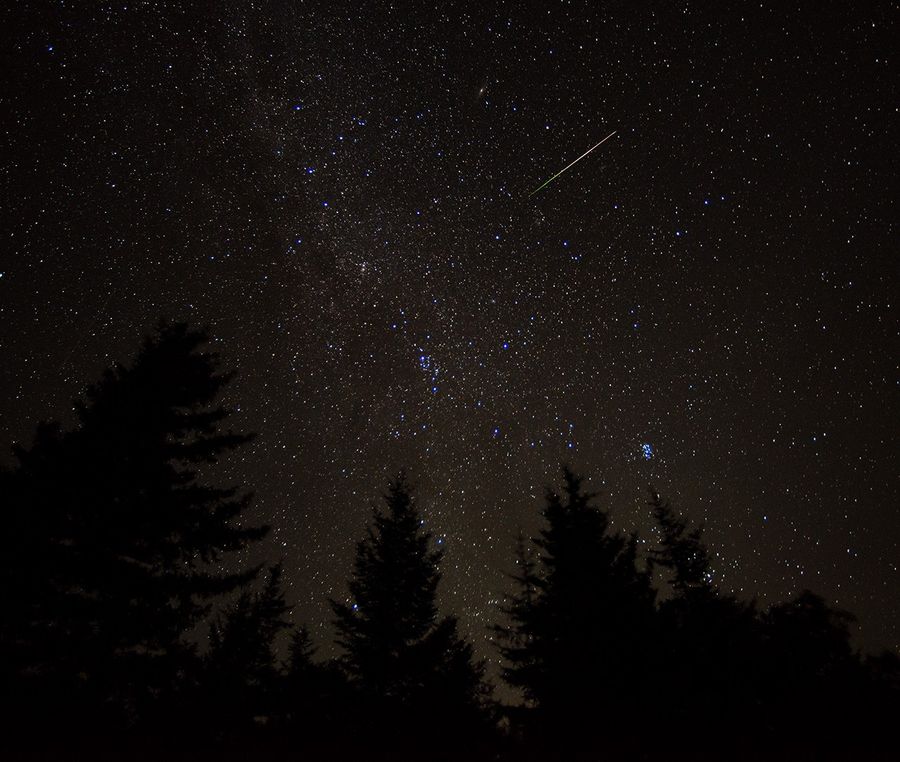
Leonids 2026: how to watch one of November’s most anticipated meteor showers from Chile
The phenomenon will reach its peak activity on the night of November 17–18. Astronomer Bruno Dias offers recommendations for observing this astronomical spectacle, especially in the hours leading up to dawn.
This week, the night sky will offer another opportunity to enjoy one of the year’s best-known astronomical phenomena: the Leonid meteor shower, which will peak between November 17 and 18. This event, which occurs annually when the Earth passes through a region of space containing particles left behind by a comet, will be visible from Chile, especially in areas far from light pollution.
Bruno Dias, Adjunct Researcher at the Center for Astrophysics and Associated Technologies (CATA) and professor at the Institute of Astrophysics at Universidad Andrés Bello (UNAB), explains the characteristics of this phenomenon and offers recommendations for those who wish to observe it in the early morning hours.
What are the Leonids, and why do they occur every year?
The Leonids are a meteor shower that occurs when the Earth passes through a region of its orbit containing small particles of rock and dust from Comet 55P/Tempel-Tuttle. When these fragments enter the Earth’s atmosphere at high speed, they produce the flashes of light we commonly know as shooting stars.
“Every year, Earth follows the same orbit around the Sun, and during that journey, it passes through regions where debris from various celestial bodies—such as comets—remains. When those small particles enter our atmosphere, they heat up and produce the flashes of light we see in the sky. That is why meteor showers are phenomena that recur at certain times of the year,” explains Dias.
The researcher points out that the names of the various meteor showers—such as the Leonids, the Eta Aquariids, and the Orionids (which occurred last October)—are related to the constellations from which their flashes appear to originate. In the case of the Leonids, this point of reference is in the constellation Leo, although the meteors can be observed in different parts of the sky.
When and how can you view the Leonids from Chile?
For those who wish to witness this astronomical spectacle, one of the best times to start observing the Leonids will be around 3:30 a.m. on November 18, when the constellation Leo begins to appear above the horizon in the east and gradually moves northward.
“Ideally, you should find a dark place, away from light pollution, with a fairly clear view of the horizon. Around 3:30 a.m., the constellation Leo will begin to appear in the east, and from there it will rise toward the north. It’s important to have a clear view of the horizon, because it won’t reach a very high altitude before sunrise,” explains the CATA researcher.
In this regard, Dias notes that the point from which the meteors appear to originate will reach an altitude of approximately 20 to 25 degrees above the horizon before sunrise. As an additional reference, the planets Jupiter and Mars will be near this region of the sky, which could make it easier to identify the constellation. Another factor favoring observation will be the absence of moonlight.
“We have a good alignment this year, because the Moon will set just before Leo begins to appear. That will help make the sky darker, allowing us to see the meteors better—especially the fainter ones, which are usually hard to make out when there’s too much light,” notes the UNAB professor.
Despite the speed at which these particles enter the atmosphere, the astronomer clarifies that this phenomenon poses no danger to the public.
For those who want more precise information about the times and position of the constellation Leo, there are astronomy apps such as Stellarium and Star Walk that allow you to view the night sky in real time and identify stars, planets, and constellations based on your geographic location.
Tips for enjoying the phenomenon
In addition to choosing a dark location with a clear view of the horizon, the researcher recommends preparing for the conditions typical of the early morning by wearing warm clothing and avoiding the light from electronic devices, which makes it harder for the eyes to adjust to the darkness.
“For those who want to get the best viewing experience, my recommendation is to go to bed early, get up around 3:30 a.m., and find a quiet spot away from city lights. Be sure to dress warmly, be patient, and let your eyes adjust to the darkness. It’s important to avoid constantly looking at your cell phone, because its light makes it difficult to see the faintest objects in the sky,” advises Dias.
Finally, the researcher notes that those who stay up late into the night will also be able to enjoy other astronomical objects, such as the planet Venus, which will appear above the horizon shortly before sunrise.
“It will be a beautiful early morning for stargazing. Those who can stay until the end will also have the chance to see Venus appear before sunrise, ending the observation with the arrival of the first rays of the sun,” concludes the CATA researcher.
Outstanding news


Recent news
-
 Publicado el: 16/11/2026Discovery of the first lunar meteorite in South America confirmed: it was found in the Atacama Desert
-
Publicado el: 16/11/2026Leonids 2026: how to watch one of November’s most anticipated meteor showers from Chile
-
 Publicado el: 12/11/2026CATA researchers take top spots in “Thesis in Three Minutes” competitions
-
 Publicado el: 05/11/2026Juan Espinoza-Retamal wins the first CATA PhD Award for his research on planetary systems
-
 Publicado el: 02/11/2026ANID renews CATA’s basal finance for five years and envisions a new phase of scientific and technological development
Categories list
- Acknowledgments 32
- Astrobiology 12
- AstroCluster 1
- Black holes 21
- Corporativo 74
- Cosmology 10
- Descubrimientos 31
- Disclosure 92
- Exoplanets 20
- Extension 14
- Galaxies 31
- Galaxies formation 12
- Inter y Transdisciplina 5
- Local Universe 22
- Publications 9
- Sin categorizar 34
- Solar System 32
- Stellar formation 14
- Technology 34
- Technology Transfer 34


