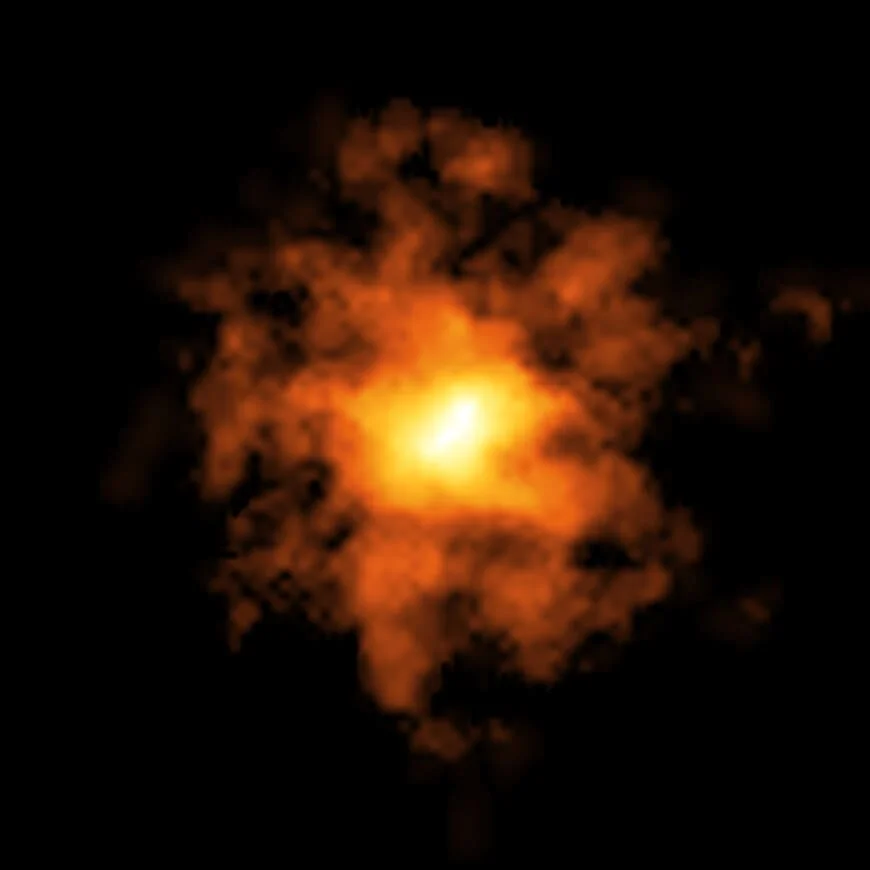
Fuel found that fueled a galaxy’s growth in the cosmic dawn
A study involving CATA researcher Manuel Aravena found that REBELS-25—a galaxy observed when the cosmos was approximately 5% of its current age—already contained an immense amount of the material needed to form stars.
An international team of astronomers has directly detected a massive reservoir of cold molecular gas in REBELS-25, a massive galaxy observed when the universe was only about 700 million years old. The discovery provides new clues about how some of the earliest galaxies managed to grow rapidly during one of the earliest stages of the cosmos.
The research involved Manuel Aravena, Associate Researcher at the Center for Astrophysics and Associated Technologies – CATA (ANID Basal Center) and professor at Universidad Diego Portales (UDP). The study combined observations obtained with the Very Large Array (VLA) in the United States and the Atacama Large Millimeter/submillimeter Array (ALMA) in Chile.
Through observations of carbon monoxide (CO)—a molecule used to detect the presence of molecular gas—the team was able to identify a massive amount of gas in this system. This is also the most distant observation of this type of signal made to date. Although astronomers suspected that the first massive galaxies must have contained large amounts of this material to explain their rapid development, there were no direct records of these deposits at such a remote distance.
“REBELS-25 is special because we’re observing it when the universe was only about 700 million years old. And yet, it doesn’t look like a galaxy in its early stages of formation, but rather a fairly well-developed system: it has dust, metals, a relatively orderly dynamic structure, and now we’re observing its enormous reserve of cold molecular gas,” explained Aravena, who is also a researcher at the Millennium Nucleus for Galaxies (MINGAL).
The CATA astronomer added that “the most important thing is that this material is the direct fuel for forming new stars. Finding such large amounts of gas in such an early galaxy tells us that some systems in the early Universe were able to accumulate material at a rapid pace. In other words, REBELS-25 had a full reservoir to continue forming stars intensively much earlier than one might imagine.”
A window into the early universe
REBELS-25 is located in the Reionization Era, a crucial period in cosmic evolution during which radiation from the first stars and galaxies ionized the neutral hydrogen in the Universe. Until then, this gas acted as a fog that blocked the passage of light; as it became ionized, the cosmos gradually became transparent, and light was able to travel freely. Understanding how these systems managed to accumulate mass in such a short time is one of the central questions of modern astronomy.
According to Aravena, this detection allows us to go beyond the indirect estimates used until now. “We often infer the amount of gas from dust, star formation, or other spectral lines such as ionized carbon (CII). But in this case, we are detecting CO, which is a classic tracer of molecular gas. This allows us to confirm with greater certainty that some very early galaxies already had enormous reserves of fuel and were therefore poised for rapid growth,” he said.
Pushing the boundaries of observation
Detecting cold gas at these distances poses a huge observational challenge, since the signal from the most distant galaxies is extremely faint. To overcome this, the team combined the capabilities of ALMA and the VLA.
“The VLA was key because it allowed us to observe a low-excitation transition of carbon monoxide—CO(3-2)—which is one of the best ways to trace cold molecular gas. ALMA, for its part, allowed us to detect a higher-excitation transition—CO(7-6)—in addition to providing information about the dust and the CII line. By combining both observations, we not only detected the presence of molecular gas but can also begin to understand its physical conditions,” explained the CATA researcher.
Aravena also emphasizes that “at the observed distances, the cosmic microwave background is much hotter and acts as a kind of bright background against which we must detect the cold gas, which reduces the contrast of the CO emission and makes it difficult to detect the signal. “These results are important because they show that, with sufficiently deep observations and the right instruments, we can still detect cold gas in galaxies from this era.”
The next challenges
The team now hopes to delve deeper into these types of observations and extend them to a larger number of galaxies from the Reionization Era. “REBELS-25 may be just the tip of the iceberg, but we need to know whether this enormous gas reservoir is common in massive early galaxies or whether it is an exceptional case. That comparison will be key to understanding how the first large galaxies in the Universe formed,” said Aravena.
Finally, the study highlights the potential of the Next Generation Very Large Array (ngVLA), which will have a unique capability for this type of research. “This instrument will have greater sensitivity, allowing for much faster measurements across larger samples of galaxies. With the ngVLA, we’ll be able to move from a single detection to statistical studies: measuring how much cold gas galaxies in the early universe contain and how this varies depending on their mass, age, and star formation,” concludes Manuel Aravena.
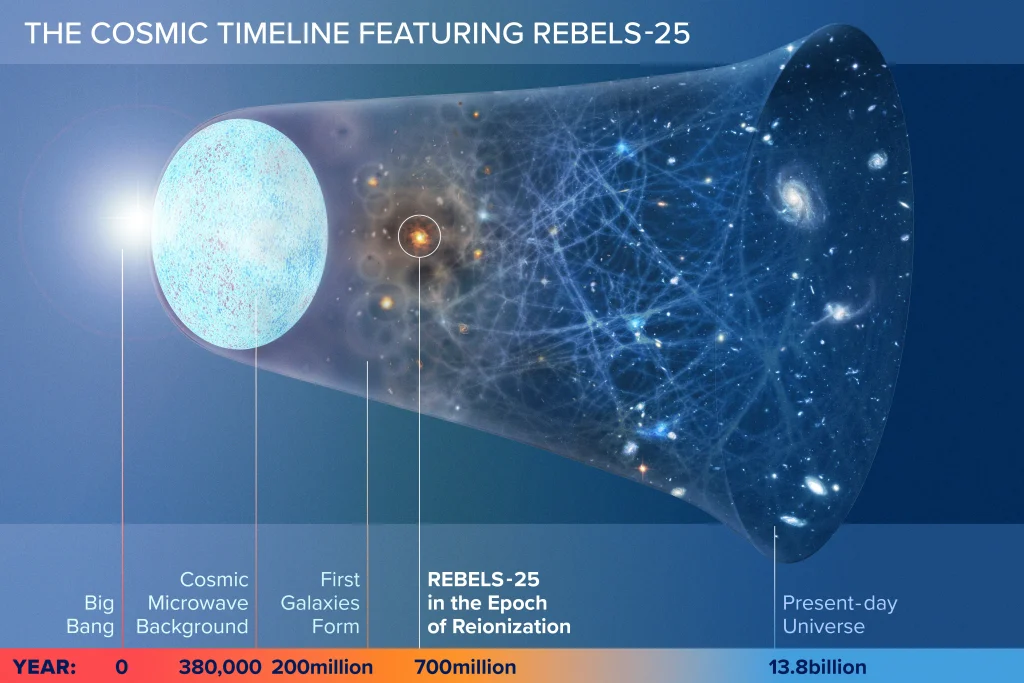
This illustration traces the evolution of the universe from the Big Bang to the present day, highlighting REBELS-25, a very distant galaxy observed during the Reionization Era, 13 billion years ago. New in-depth observations made with the NSF’s VLA and ALMA reveal that REBELS-25 already possessed a vast reservoir of cold molecular gas—the direct fuel for star formation—when the universe was only 700 million years old. Credit: NSF/AUI/NSF NRAO/M. Weiss.
Outstanding news

Recent news
-
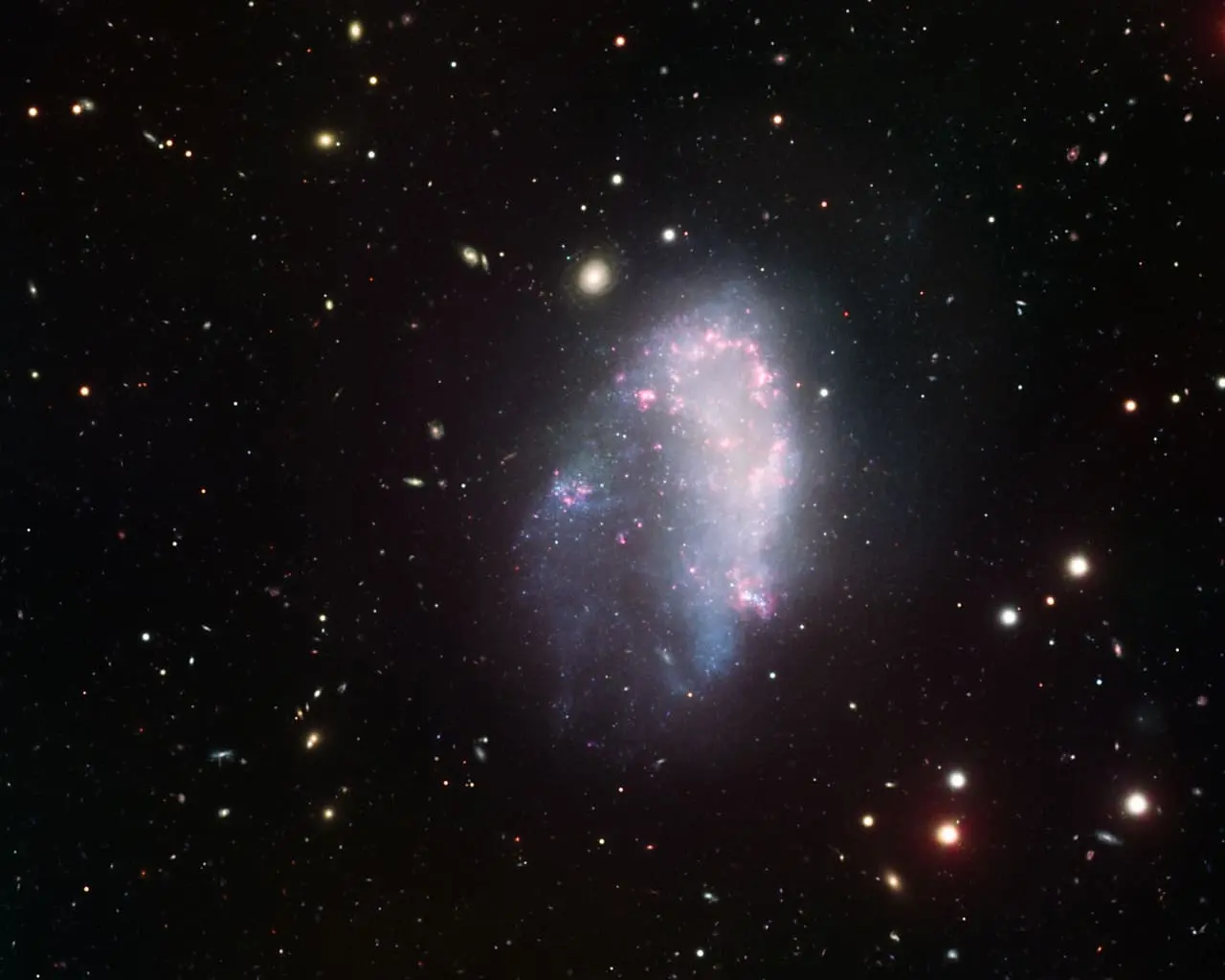 Publicado el: 19/10/2026Study led by CATA researchers solves a 30-year-old mystery about a dwarf galaxy
 -
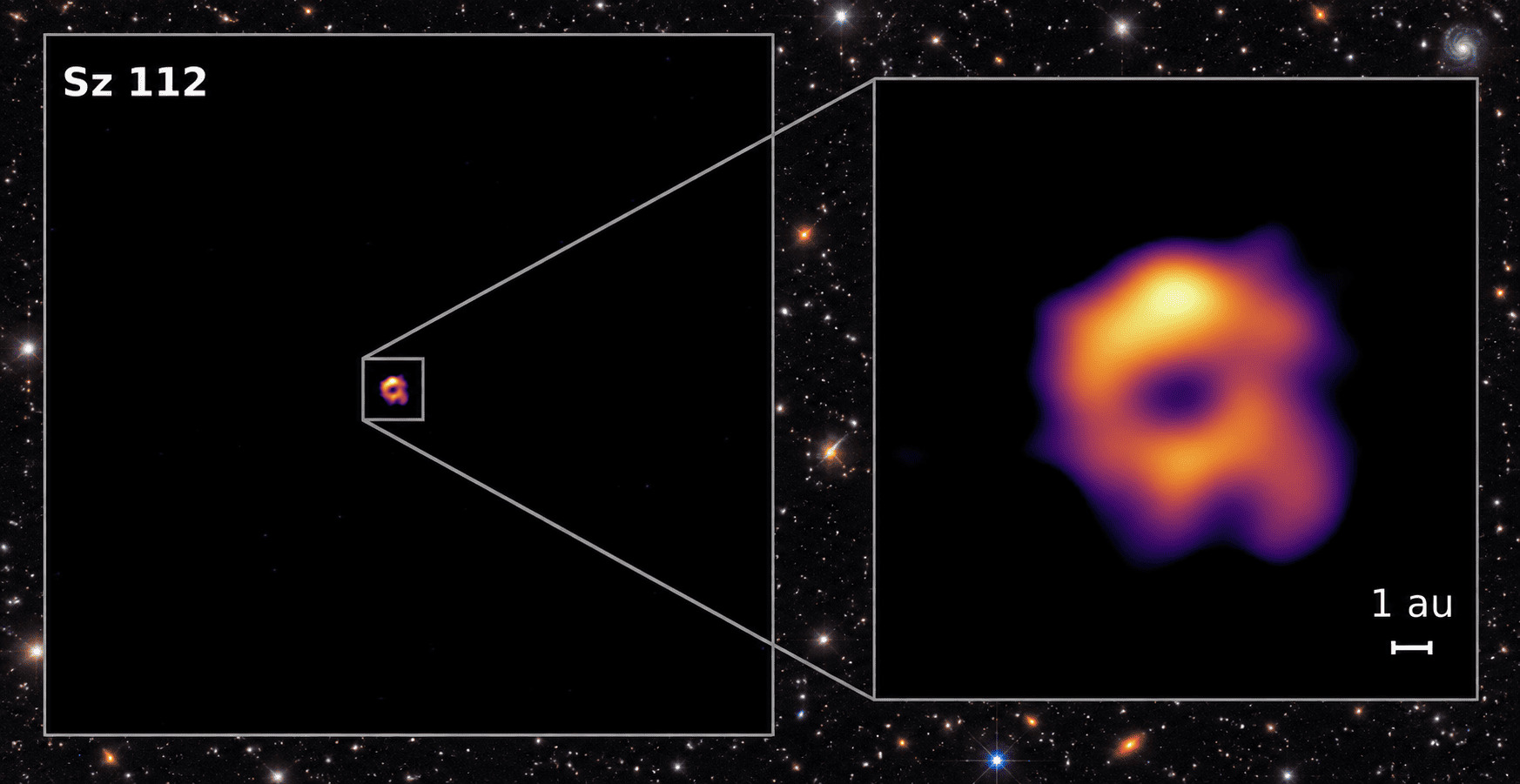 Publicado el: 15/10/2026Structures potentially associated with the formation of super-Earths and mini-Neptunes have been detected in compact disks
 -
 Publicado el: 09/10/2026From studying the universe to solving industry challenges: CATA’s technology transfer model in Nature Astronomy
 -
 Publicado el: 01/10/2026CATA Associate Researcher concludes research stay at the University of São Paulo thanks to a Brazilian fellowship
 -
 Publicado el: 29/09/2026Chilean technology aims to improve the accuracy of telescopes studying the origin of the Universe
Categories list
- Acknowledgments 29
- Astrobiology 12
- AstroCluster 1
- Black holes 21
- Corporativo 73
- Cosmology 10
- Descubrimientos 30
- Disclosure 91
- Exoplanets 19
- Extension 14
- Galaxies 29
- Galaxies formation 11
- Inter y Transdisciplina 5
- Local Universe 22
- Publications 9
- Sin categorizar 34
- Solar System 30
- Stellar formation 12
- Technology 33
- Technology Transfer 34