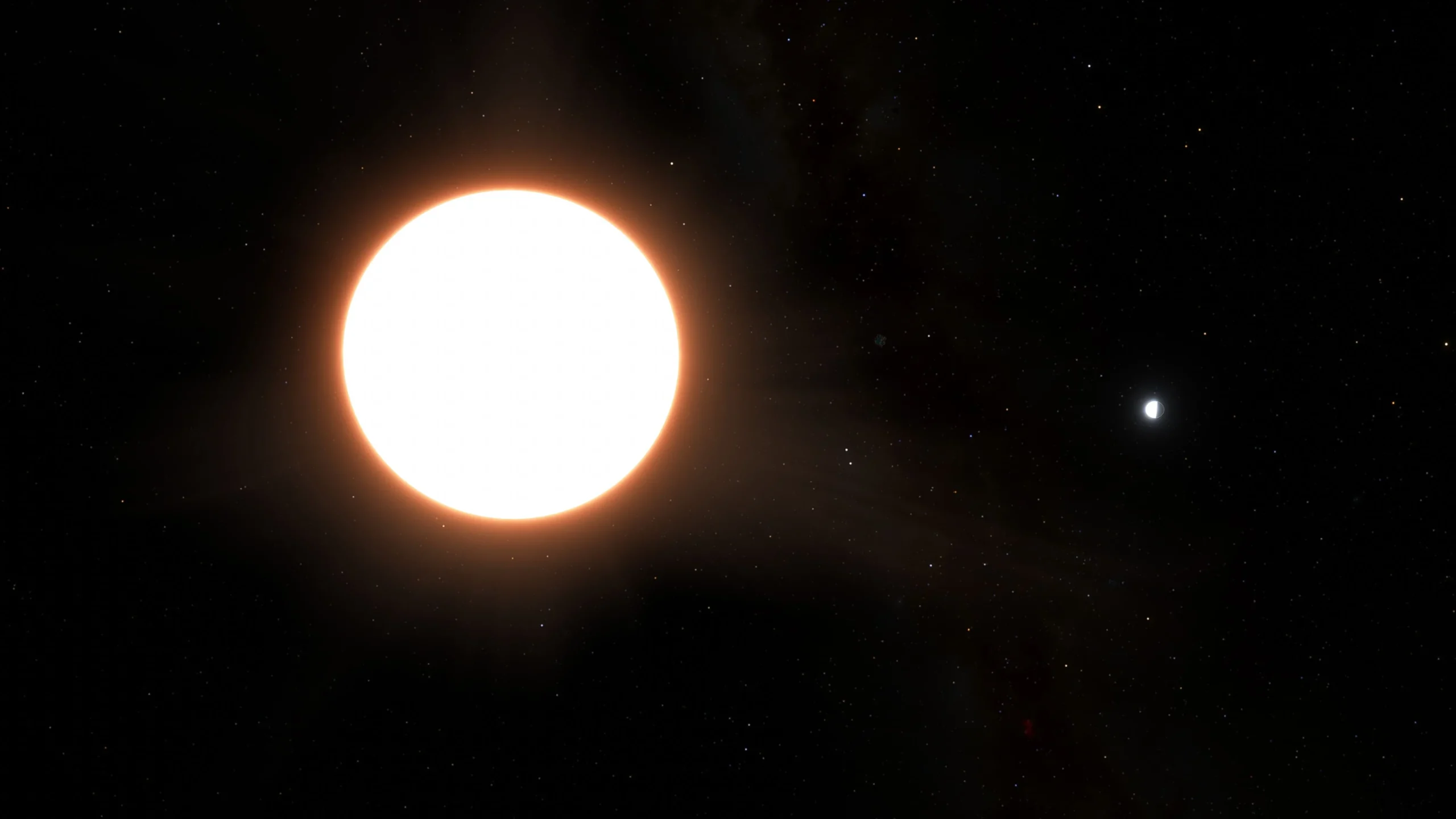
Silicate clouds discovered in the daytime atmosphere of the only ultra-hot Neptune
The discovery, which involved the Center for Astrophysics and Associated Technologies (CATA), provides the first precise explanation for the unusual brightness of the exoplanet LTT9779b.
Discovered in 2020, LTT9779b is, to date, the only known “ultra-hot Neptune”: a Neptune-sized planet that orbits very close to its star, completing one full orbit in just 19 hours and reaching temperatures exceeding 2,000°K on its day side.
Since its discovery, this object has attracted attention for its brightness, reflecting nearly 80% of its star’s light—far more than any other known giant planet. Previous observations had detected this extreme brightness, but could not explain whether it was due to clouds in its atmosphere or to an unusually high concentration of metals in it.
A new study, published in the journal The Astrophysical Journal Letters and led by researchers from the Center for Astrophysics and Associated Technologies – CATA (project financed by ANID), has resolved this question. Using the NIRISS and NIRSpec instruments on the James Webb Space Telescope (JWST), the team analyzed the light emitted by the planet across a wide range of wavelengths (colors), from the visible to the infrared, allowing them to study its atmosphere in unprecedented detail.
The study was led by Suman Saha, who was a Postdoctoral Researcher at CATA during the research process, and James Jenkins, Principal Investigator at CATA and professor at Universidad Diego Portales (UDP), along with other international scientists.
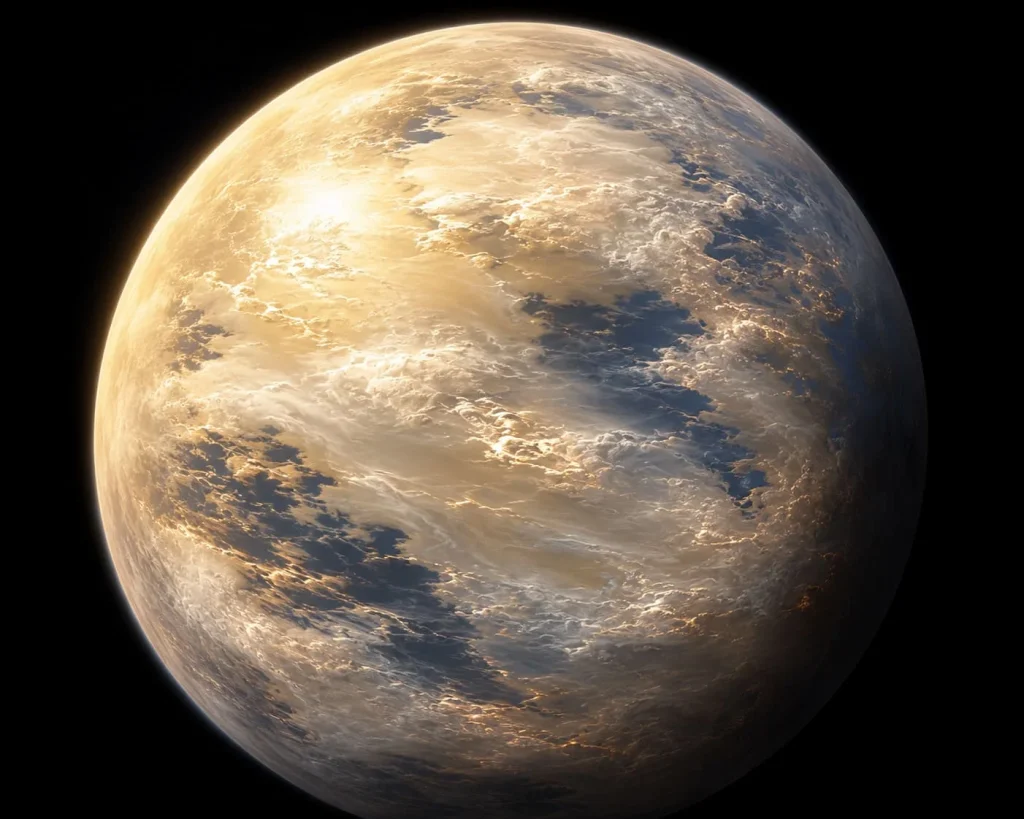
The results confirmed the presence of magnesium silicate (Mg₂SiO₄) clouds in the planet’s daytime atmosphere. Unlike the water clouds we know on Earth, these are made of a much more exotic material, similar to glass or quartz, which forms only at extremely high temperatures. These particles very efficiently scatter the light they receive from their star, especially in the visible and infrared ranges, causing much of that light to bounce back into space rather than being absorbed.
This is the first statistically significant detection of clouds on the day side of a Neptune-mass exoplanet, confirming that these clouds are highly reflective and responsible for the planet’s intense brightness.
“The albedo of LTT9779b is much higher than that of any other known gas giant. Despite being the size of Neptune, this object is analogous to ultra-hot Jupiters, with a temperature on its day side exceeding 2,200°K, where even refractory minerals such as rocks can vaporize,” notes Suman Saha.
The study also detected carbon monoxide (CO) and carbon dioxide (CO₂) in the planet’s atmosphere, in addition to providing an initial estimate of the abundance of water (H₂O). Based on these measurements, the team determined that LTT9779b has a carbon-to-oxygen (C/O) ratio much higher than that of the Sun, comparable to that of other “ultra-hot Jupiters,” but unusual for cooler gas giants.
“CO and CO₂ are, along with water, the most abundant molecules in the atmospheres of these types of planets after hydrogen and helium. Effectively measuring the amount of each allows us to accurately calculate this (C/O) ratio in their atmospheres, which is considered an important indicator of the formation and evolution of these worlds,” explains Suman Saha.
To analyze the data, the team used Geryon-3, the supercomputing cluster at the Center for Astrophysics and Associated Technologies – CATA. Using this cluster, they performed calculations that allowed them to reconstruct—based on the light captured by the JWST—the chemical composition of the planet’s atmosphere and confirm the presence of clouds.
“This cluster was essential for carrying out the computationally intensive analyses conducted in this study, particularly the complex atmospheric reconstructions that were crucial for detecting and characterizing the silicate clouds,” says James Jenkins.
In addition to explaining these characteristics, the results provide new insights into how the atmospheres of planets subjected to extreme temperatures evolve. By comparing their composition with that observed in other gas giants, the study helps identify processes that may be common across different types of exoplanets and contributes to our understanding of the origin of planetary diversity. Therefore, this study serves as an important milestone toward achieving that goal.
“The study provides some of the first observational evidence of this atmospheric evolutionary pathway in ultra-hot atmospheres, and extends to Neptune-sized gas giants a scenario that had previously been proposed only for Jupiter-sized ones,” Jenkins notes.
Finally, the researchers emphasize that they will continue working to gain an even better understanding of how the atmosphere and clouds form and evolve on these unique planets, as new opportunities arise thanks to the growing availability of high-precision observations from the JWST and future instruments such as the Giant Magellan Telescope (GMT) and the Extremely Large Telescope (ELT).
“We plan to continue collaborating with researchers from around the world to conduct large-scale studies of extreme exoplanets and their cooler counterparts. These efforts aim to understand how planetary diversity shapes atmospheric evolution and whether planets with vastly different current atmospheres still retain traces of their common origins,” concludes Suman Saha.
Outstanding news
Recent news
-
 Publicado el: 19/10/2026CATA will contribute to data processing for a major international astronomy project
 -
 Publicado el: 19/10/2026Study led by CATA researchers solves a 30-year-old mystery about a dwarf galaxy
 -
 Publicado el: 15/10/2026Structures potentially associated with the formation of super-Earths and mini-Neptunes have been detected in compact disks
 -
 Publicado el: 09/10/2026From studying the universe to solving industry challenges: CATA’s technology transfer model in Nature Astronomy
 -
 Publicado el: 01/10/2026CATA Associate Researcher concludes research stay at the University of São Paulo thanks to a Brazilian fellowship
Categories list
- Acknowledgments 29
- Astrobiology 12
- AstroCluster 1
- Black holes 21
- Corporativo 73
- Cosmology 10
- Descubrimientos 30
- Disclosure 91
- Exoplanets 19
- Extension 14
- Galaxies 29
- Galaxies formation 12
- Inter y Transdisciplina 5
- Local Universe 22
- Publications 9
- Sin categorizar 34
- Solar System 30
- Stellar formation 13
- Technology 34
- Technology Transfer 34