

CATA will contribute to data processing for a major international astronomy project
The Center will contribute to data processing for the Local Volume Mapper, an initiative that studies star formation in the Milky Way and nearby galaxies. The work will be led by Postdoctoral Researcher Alfredo Mejía.
The Center for Astrophysics and Associated Technologies (CATA), project financed by ANID, will assume technical responsibility for the Sloan Digital Sky Survey (SDSS-V), one of the world’s largest international astronomical collaborations. This will be done through an agreement with the Astrophysical Research Consortium (ARC), which involves the development and maintenance of software tools used to process large volumes of astronomical data.
SDSS-V is the fifth generation of this survey, an initiative that has been conducting various observational programs to study the universe since the 1990s. Its current phase comprises three lines of research: the Milky Way Mapper, focused on the Milky Way; the Black Hole Mapper, dedicated to the study of black holes; and the Local Volume Mapper (LVM), aimed at understanding star formation processes in our galaxy and its neighbors. To this end, it uses astronomical facilities in the United States and Chile, generating data that is made available to the scientific community.
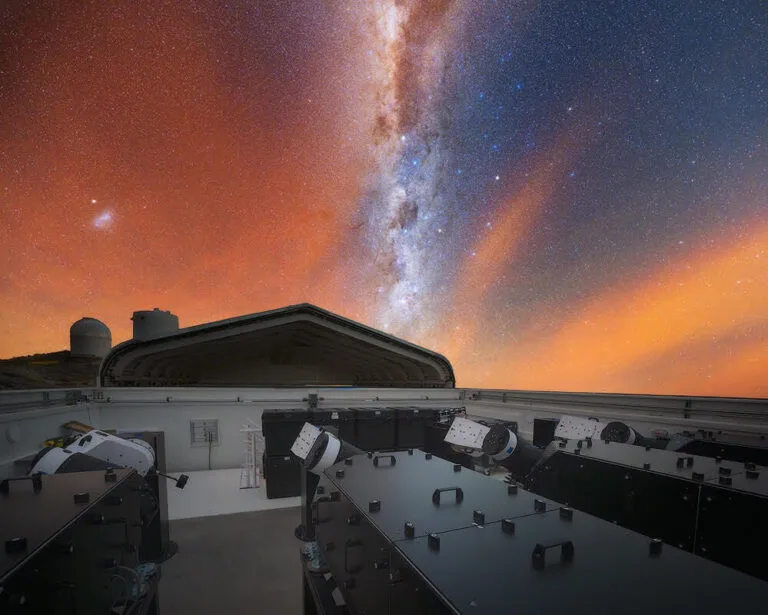
CATA’s work will focus on the Local Volume Mapper (LVM), which uses a state-of-the-art spectroscopic instrument—fed by 16-centimeter robotic telescopes installed at the Carnegie Science Las Campanas Observatory—to study star-forming regions in our galaxy and its neighbors. Through spectroscopic observations, this initiative aims to understand how young stars interact with the gas surrounding them, what physical mechanisms govern their formation, and how these phenomena influence the evolution of galaxies.
To answer these questions, the LVM generates millions of spectra that must be processed and calibrated before they can be used in scientific research. It is precisely at this stage that CATA will participate in refining the Data Reduction Pipeline (DRP), a specialized software program that transforms telescope observations into reliable scientific data by correcting for effects introduced by the instruments and the observation process itself.
Technological development from Chile
The technical work is led by Alfredo Mejía, Postdoctoral Researcher at CATA and the Universidad de Chile, who currently serves as a data reduction scientist at the LVM. His responsibilities will include overseeing the processing of scientific data and calibration images, evaluating the quality of the results, identifying potential instrumental issues, and developing improvements to optimize the software’s performance.
In this context, the agreement also provides for the development of new versions of the DRP, the preparation of technical documentation, the refinement of quality control mechanisms, and knowledge-transfer activities for other members of the international collaboration. The goal is to have tools capable of processing large amounts of data in a reproducible manner, facilitating their subsequent use in astronomical research.
“Data reduction lies, in a sense, at the interface between instrumentation and the science we want to conduct with it. The goal is to transform the images obtained by the detectors into data that represent the light from astronomical objects as faithfully as possible, removing the effects introduced by the instrument and by the observation process itself,” explained Mejía.
For his part, Guillermo Blanc, Associate Researcher at CATA, Director of the Carnegie Science Las Campanas Observatory, and adjunct professor at the Universidad de Chile, will serve as the Center’s technical counterpart to ARC, assisting in monitoring progress and coordinating efforts with the international team.
For the astronomer, taking on this responsibility represents a step forward in the technological capabilities that CATA has developed to contribute to large-scale scientific initiatives. “This role positions CATA at the forefront of developing the data infrastructure for one of the most important international astronomy projects. It reflects the quality of the capabilities the Center has established in the country in terms of technological development for astronomical research, and opens the door to future international collaborations in areas related to software development and large-scale data processing,” he noted.
Contribution to international astronomy
The agreement provides for a two-year implementation period, from November 2026 to October 2028, during which CATA, through Mejía, will work on refining the tools needed to prepare future LVM data releases for the scientific community.
This project will strengthen the technological infrastructure that supports the analysis of large volumes of astronomical data, facilitating research on the formation and evolution of stars, as well as their interaction with the interstellar medium.
For the Center’s Postdoctoral Researcher, participating in this project also represents an opportunity to contribute from Chile to a field of astronomical research that encompasses both scientific analysis and the development of technological tools used by the international community.
“Being able to do this from CATA and from Chile is especially significant, because it allows our community to participate directly in an international project of this scale and to contribute—in addition to the scientific analysis of the data—to the infrastructure that makes this science possible,” he said.
Thus, the agreement formalizes CATA’s technical contribution to SDSS-V and strengthens its involvement in the development of tools that will make it possible to analyze the data obtained by the LVM, thereby contributing to the study of star formation and the physical processes involved in the evolution of galaxies.
Image Cover: The four telescopes of Local Volume Mapper with the Milky Way and Small Magellanic Cloud (SMC) behind them. The telescopes are parked here and are not observing. Credit: SDSS/Yuri Beletzki
Outstanding news
Recent news
-
Publicado el: 19/10/2026CATA will contribute to data processing for a major international astronomy project
-
 Publicado el: 19/10/2026Study led by CATA researchers solves a 30-year-old mystery about a dwarf galaxy
-
 Publicado el: 15/10/2026Structures potentially associated with the formation of super-Earths and mini-Neptunes have been detected in compact disks
-
 Publicado el: 09/10/2026From studying the universe to solving industry challenges: CATA’s technology transfer model in Nature Astronomy
-
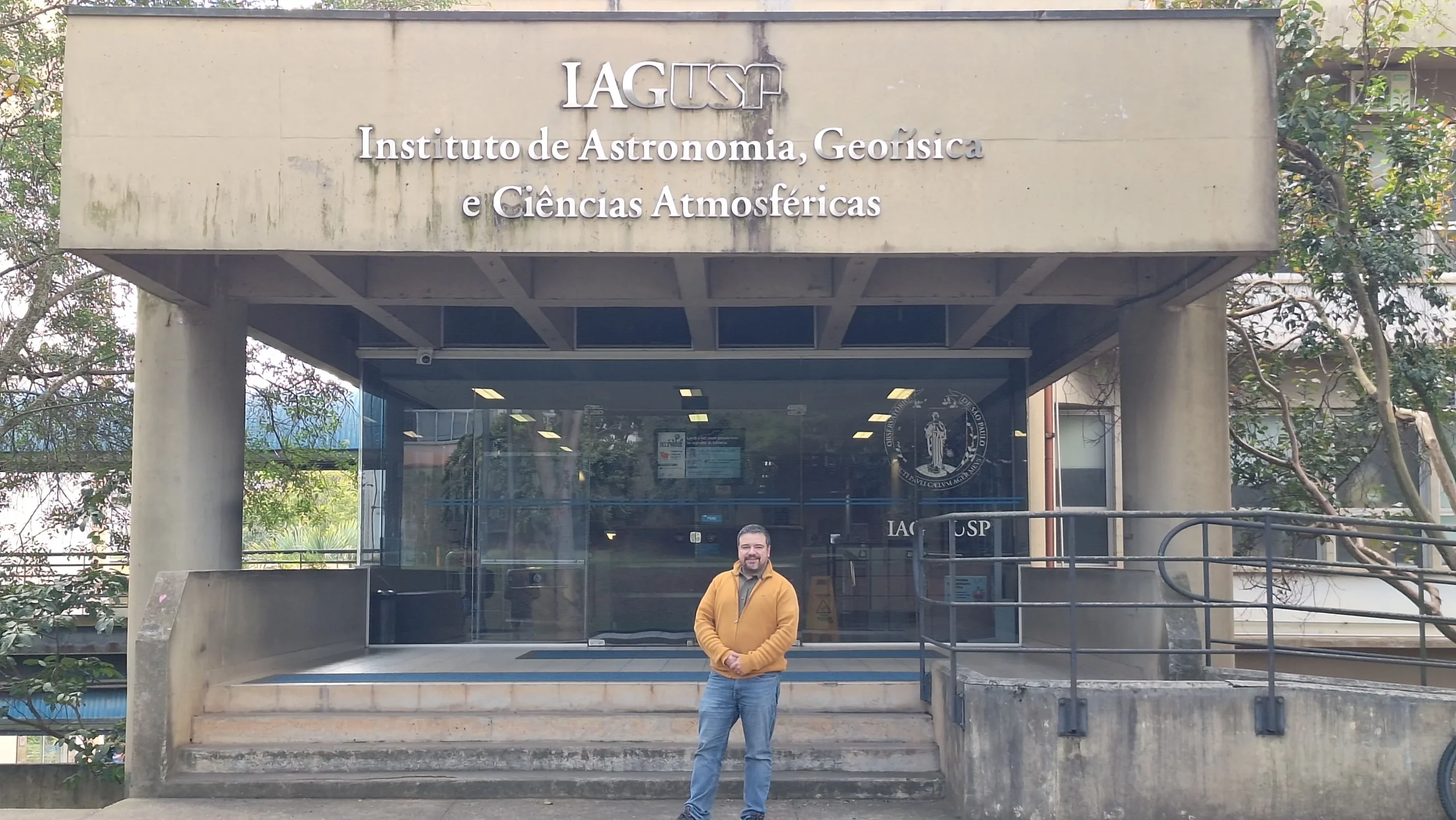 Publicado el: 01/10/2026CATA Associate Researcher concludes research stay at the University of São Paulo thanks to a Brazilian fellowship
Categories list
- Acknowledgments 29
- Astrobiology 12
- AstroCluster 1
- Black holes 21
- Corporativo 73
- Cosmology 10
- Descubrimientos 30
- Disclosure 91
- Exoplanets 19
- Extension 14
- Galaxies 29
- Galaxies formation 12
- Inter y Transdisciplina 5
- Local Universe 22
- Publications 9
- Sin categorizar 34
- Solar System 30
- Stellar formation 13
- Technology 34
- Technology Transfer 34


