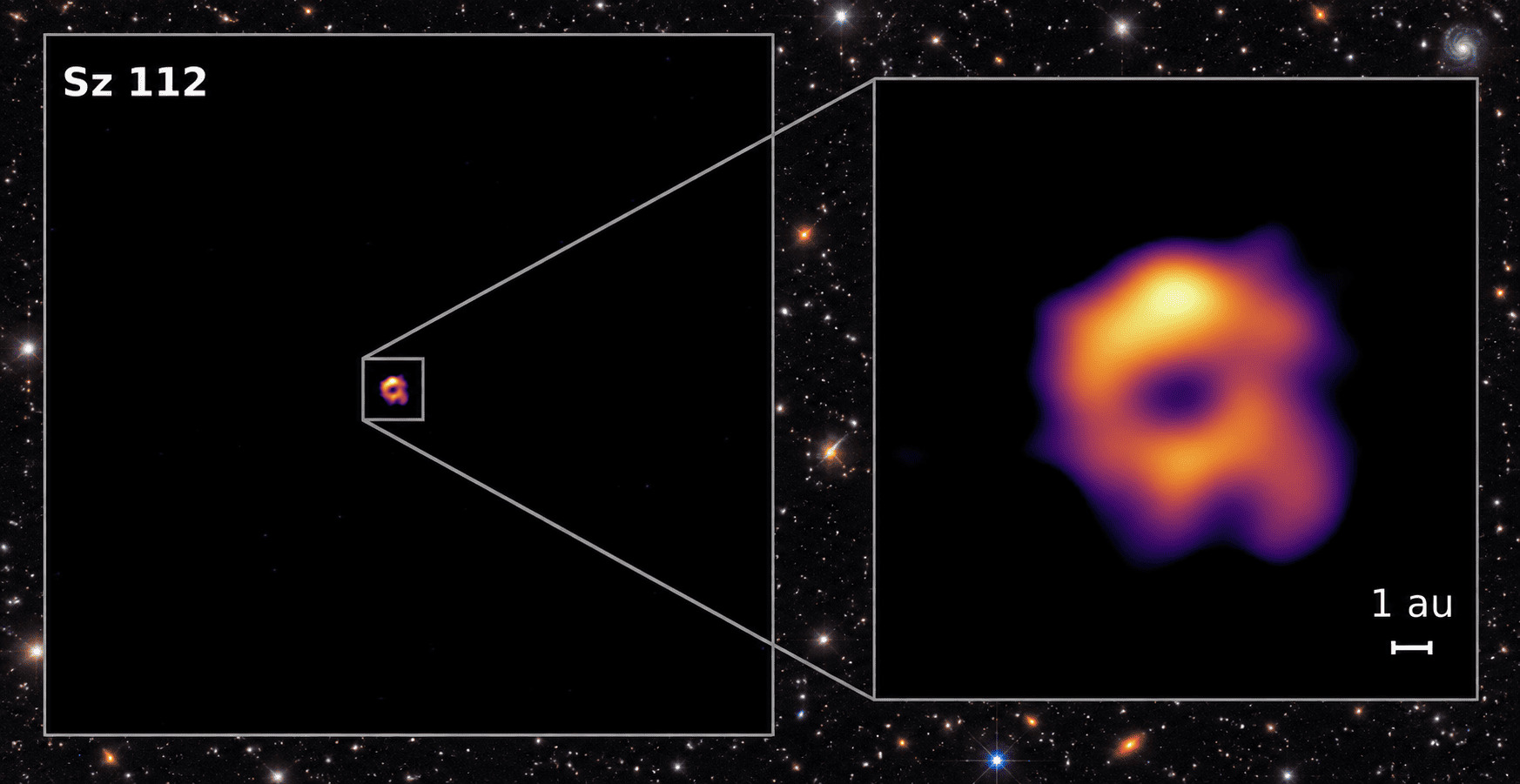
Structures potentially associated with the formation of super-Earths and mini-Neptunes have been detected in compact disks
A study led by Pietro Curone, CATA Postdoctoral Researcher, detected rings, gaps, and cavities in small protoplanetary disks. The study, conducted using the ALMA radio telescope, shows that these structures can go unnoticed when the resolution is not high enough to observe them.
The gas and dust disks surrounding young stars are the environments where planets form. Although astronomical observations have revealed complex structures in large, bright disks, more compact systems have appeared relatively smooth and featureless, raising the question of whether they evolve differently or whether their structures have simply been too small to be visible.
A new study, published in The Astrophysical Journal Letters and led by Pietro Curone, CATA Postdoctoral Researcher at the Center for Astrophysics and Associated Technologies – CATA (project financied by ANID), shows that these disks may also contain structures that provide clues about planet formation processes.
Revealing details in small-sized discs
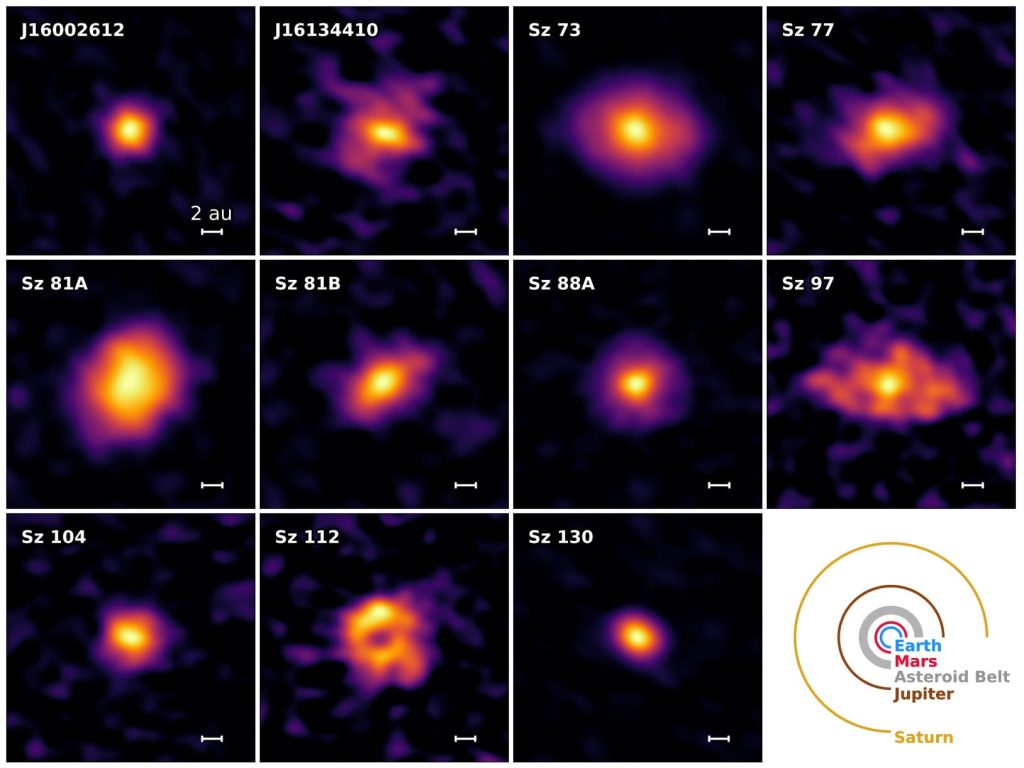
The study used the Atacama Large Millimeter/submillimeter Array (ALMA) to observe 11 extremely compact protoplanetary disks in the Lupus star-forming region. The observations were conducted in Band 7, at a wavelength of approximately 0.9 millimeters, achieving an angular resolution of 0.02 arcseconds, equivalent to 2 astronomical units (AU)—in other words, twice the average distance between Earth and the Sun.
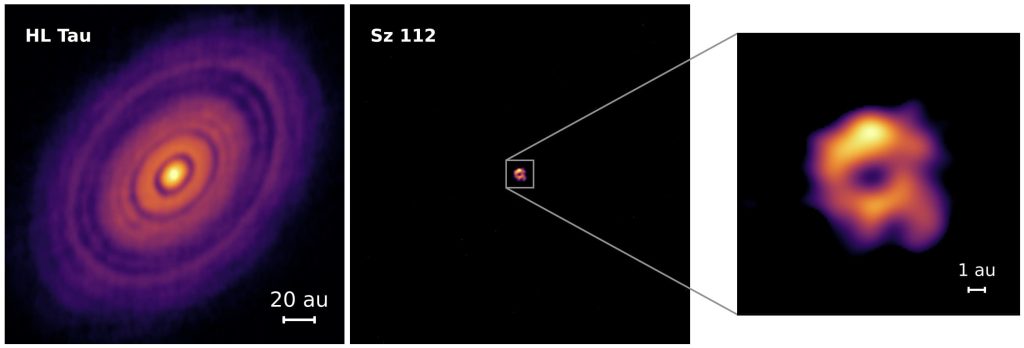
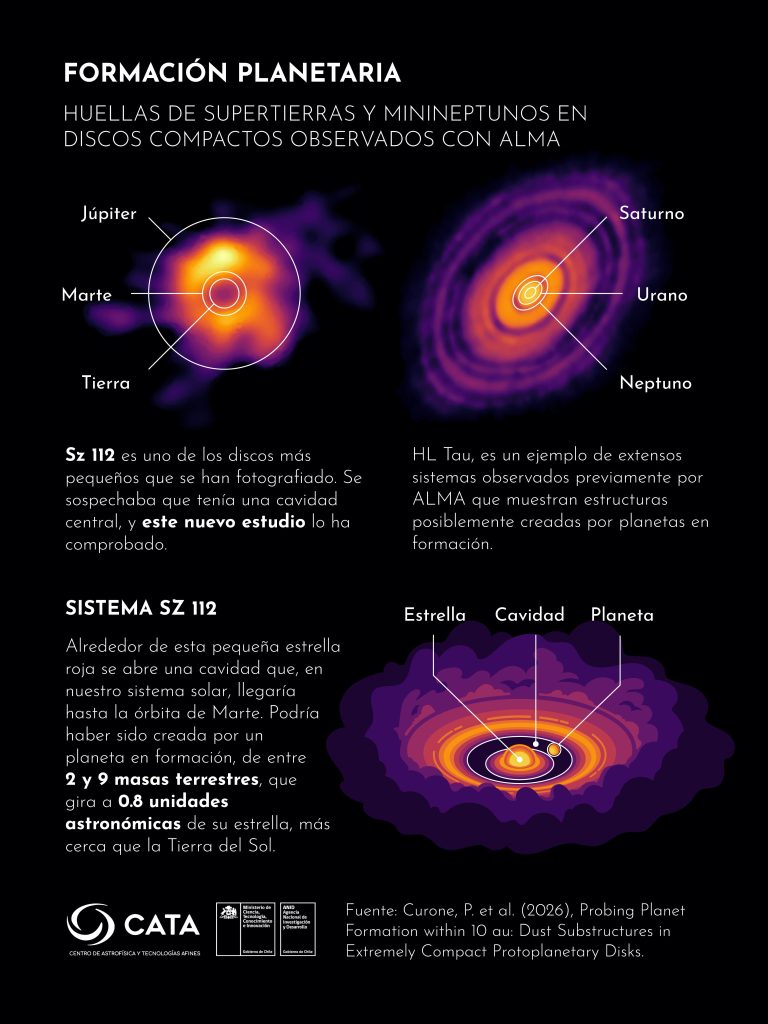
Thanks to this level of detail, the team identified internal substructures in four disks and found evidence of similar features in three others. Among the results, Sz 112 stands out, where it was possible to distinguish a central cavity extending up to 1.6 AU from the star. In addition, two systems, Sz 73 and Sz 130, showed faint rings extending far beyond their bright central disks. Likewise, four other systems show preliminary signs of similar outer emission. These results raise the possibility that some disks classified as very small may contain more extensive material that had remained hidden due to their low luminosity.
“Seeing substructures in these disks is important because it shows us that even very compact disks—which in previous observations always appeared smooth—also have substructures with rings, gaps, and internal cavities, just as is the case in much larger and more massive disks,” explains Curone, who is also postdoctoral researcher at the Universidad de Chile and the Pontificia Universidad Católica de Chile (UC), where he receives academic supervision from both institutions.
The astronomer adds that these structures make it possible to estimate the mass of the potential planets that could have formed them, which, in the cases studied, would fall within the range of super-Earths and mini-Neptunes. This opens up new opportunities to investigate how planets with these characteristics form in regions close to their stars—an area of particular interest because many known exoplanets orbit at relatively close distances.
The study also included the participation of Gijs Mulders, CATA Associate Researcher and professor at UC; Laura Pérez, CATA Principal Researcher and professor at the U. de Chile; and Nienke van der Marel, researcher at the Leiden Observatory in the Netherlands.
Structures that could promote planet formation
For Mulders, one of the key aspects of the study is the possibility of identifying structures that could promote planet formation in regions closer to young stars. Among these are what are known as pressure traps (pressure traps), areas of the disk where solid particles can accumulate.
“Generally, these structures are observed farther from the star, in large, massive disks, while exoplanets orbit closer. Finding them so close to the stars, in compact, lightweight disks, suggests that these may be the places where the exoplanets themselves form.”
These structures are significant because the solid particles present in the disks tend to move inward, toward the star. The rings and gaps may be associated with changes in gas pressure that slow this migration and allow dust to accumulate in certain regions. In this way, they could create conditions favorable for the growth of solid material and contribute to planet formation.
Resolution makes all the difference
A comparison with previous observations also revealed that the frequency with which these structures are detected depends on the size of the disks and the resolution of the images. Among the disks observed in sufficient detail, substructures were identified in approximately 44% of the extremely compact systems, with radii between 3 and 10 AU, and in about 55% of those with radii between 10 and 30 AU. In disks larger than 30 AU, the proportion exceeds 90%. These differences suggest that the lower detection rate of structures in small disks was due, at least in part, to observational limitations and not necessarily to their absence.
“The key question for us was whether the small disks truly lacked structure or whether their features simply lay beyond our resolution limit,” Mulders notes. “To answer this, we compared the new observations of compact disks with previous ALMA studies of protoplanetary disks.”
However, the researchers caution that the rings, gaps, and cavities may not be direct detections of planets, as they can also be produced by other physical mechanisms. Although a forming planet could explain some of the identified structures, further observations are needed to determine their origin.
Along these lines, Laura Pérez highlights how the ability to distinguish finer details can change our interpretation of these systems. “This is a good example of how our understanding changes when we increase the resolution. A disk that appears smooth at low resolution can reveal a rich internal structure as soon as we are able to distinguish details separated by just a few astronomical units,” says the astronomer.
Future observations to help us understand these systems
The results suggest that large, compact disks may share similar physical processes and structures, even though these occur on different scales. Future high-resolution observations—using more extensive arrays or the upcoming Next Generation Very Large Array (ngVLA)—will make it possible to determine how common these structures are and whether they correspond to locations where new planets are forming.
These long-term studies will also help determine whether the rings, gaps, and cavities identified correspond to the locations where new planets are forming.
Outstanding news
Recent news
-
Publicado el: 15/10/2026Structures potentially associated with the formation of super-Earths and mini-Neptunes have been detected in compact disks
-
 Publicado el: 09/10/2026From studying the universe to solving industry challenges: CATA’s technology transfer model in Nature Astronomy
 -
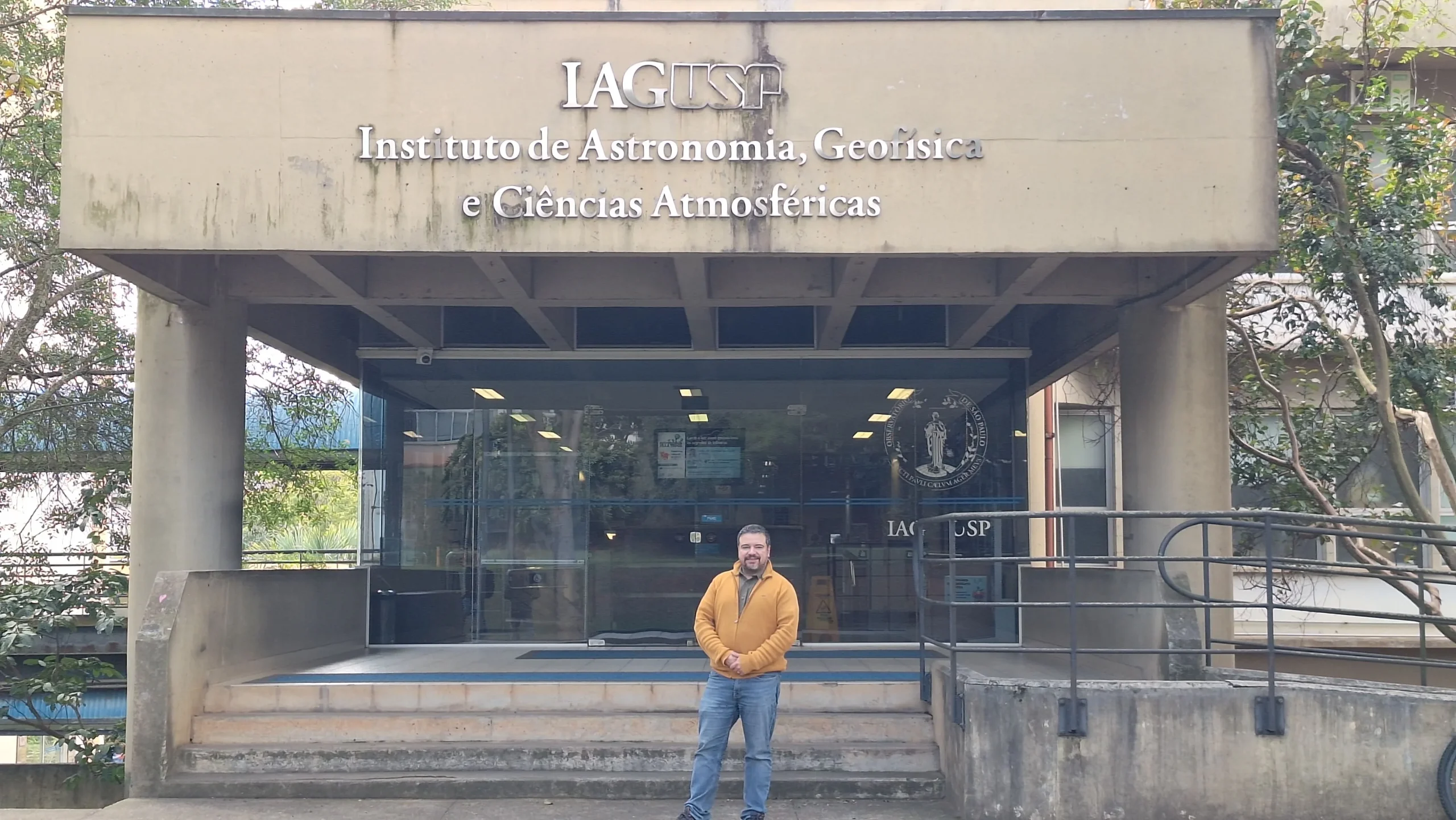 Publicado el: 01/10/2026CATA Associate Researcher concludes research stay at the University of São Paulo thanks to a Brazilian fellowship
 -
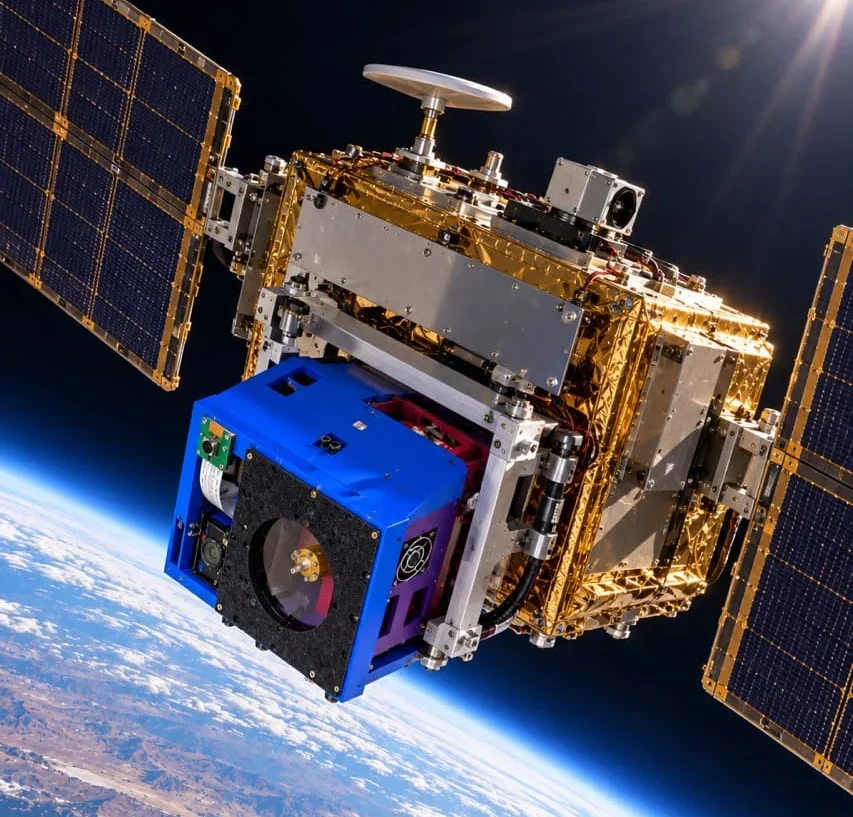 Publicado el: 29/09/2026Chilean technology aims to improve the accuracy of telescopes studying the origin of the Universe
 -
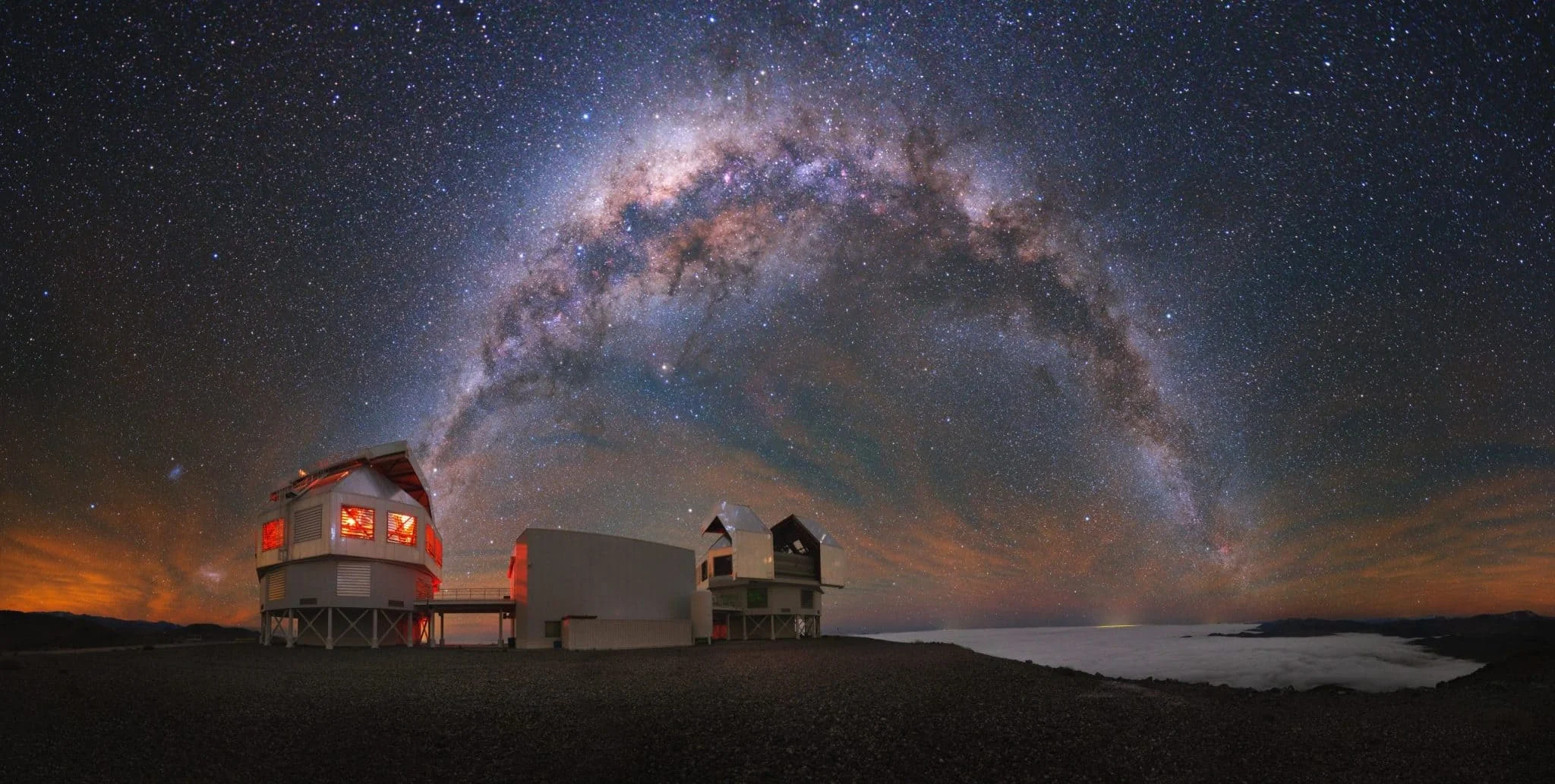 Publicado el: 25/09/2026CATA Associate Researcher named Director of the Las Campanas Observatory
Categories list
- Acknowledgments 29
- Astrobiology 12
- AstroCluster 1
- Black holes 21
- Corporativo 73
- Cosmology 10
- Descubrimientos 29
- Disclosure 91
- Exoplanets 19
- Extension 14
- Galaxies 28
- Galaxies formation 10
- Inter y Transdisciplina 5
- Local Universe 22
- Publications 9
- Sin categorizar 34
- Solar System 30
- Stellar formation 12
- Technology 33
- Technology Transfer 34