The wedding dance of massive stars: Astronomer from CATA and the Universidad de Chile contributes to historic discovery
An international team, including Guido Garay, National Prize for Exact Sciences laureate, succeeded in reconstructing—for the first time—the three-dimensional orbit of two forming giant stars.
Imagine two colossal masses of gas and dust forming independently, separated by the vastness of dark space, until a gravitational dance draws them into a stellar union that seals their fates forever. It sounds like the plot of a Hollywood movie, but it is the fascinating reality that has just been revealed by a team of astronomers, with significant contributions from the Center for Astrophysics and Associated Technologies – CATA (project financied by ANID) and the Department of Astronomy (DAS) at the Universidad de Chile.
Today marks a milestone for the global astronomy community. The article “An eccentric massive protobinary assembled via a core-merger parabolic encounter” has just been published in *Nature Astronomy*. This study not only offers us a never-before-seen glimpse of our universe, but also shifts the paradigm regarding how binary systems containing the most colossal stars we know of form.
The mystery of binary systems of giant stars
Until the publication of this paper, astrophysics was at a crossroads. Professor Guido Garay, Principal Researcher at CATA, full professor at the Faculty of Physical Sciences at the Universidad de Chile, and Scientific Director of the South American Center for Astronomy of the Chinese Academy of Sciences (CASSACA), explains it as follows: “It is estimated that at least 90% of massive stars exist in binary or multiple star systems; however, the formation mechanisms of such systems are unclear.”
Understanding the formation of these binary systems is a fundamental problem in modern astronomy. To determine how they form, it was necessary to directly measure the three-dimensional motions of these celestial bodies—a technical challenge that had proven exceptionally difficult.
Eight years of cosmic surveillance
The team, led by Professor Yichen Zhang of Shanghai Jiao Tong University in China (who knows our country very well after having been a postdoctoral researcher at Cerro Calán from 2014 to 2016), did not give up in the face of the challenge.
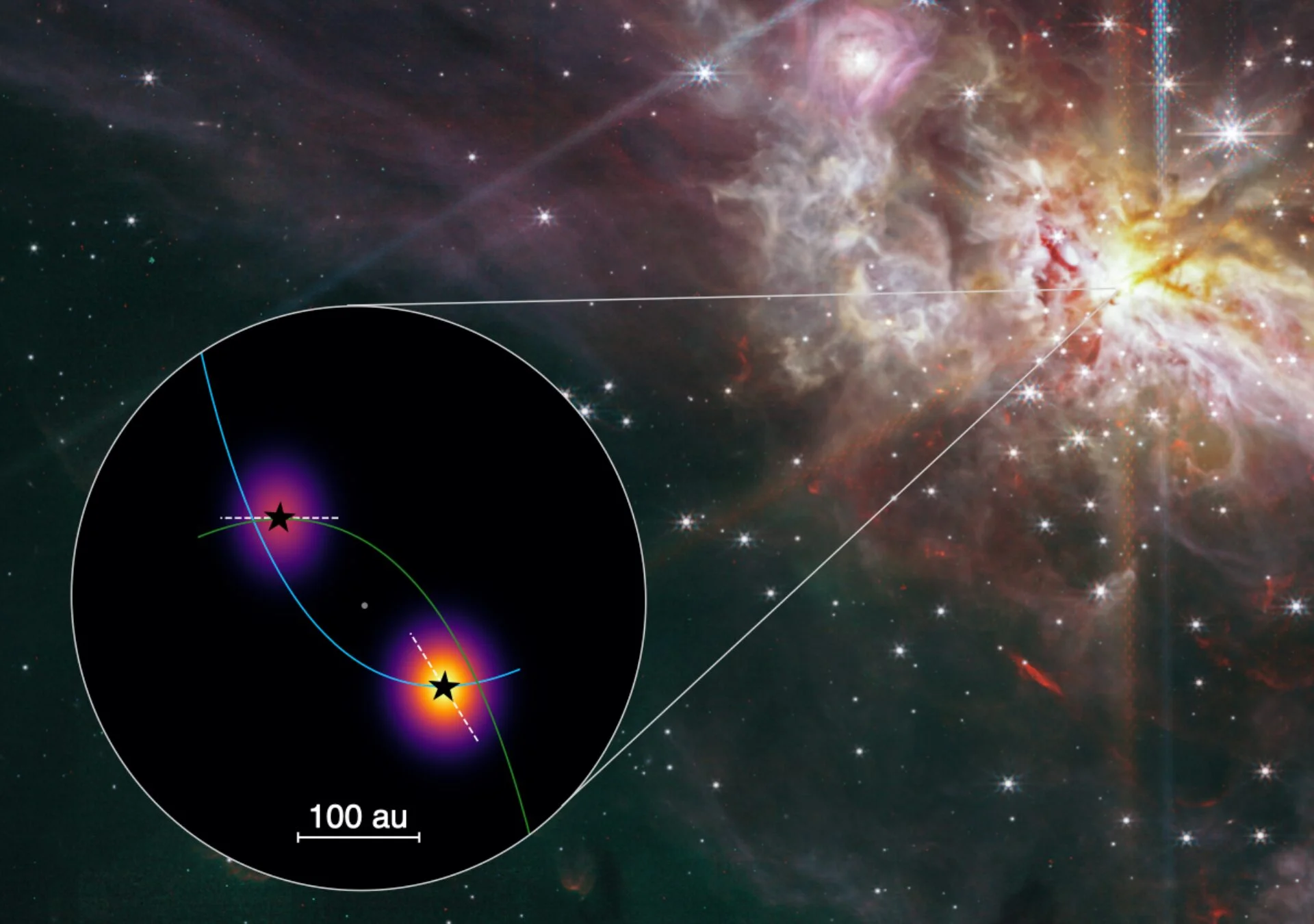
They turned their attention to IRAS 07299-1651, a young, massive protostellar binary system located 1,680 parsecs away. To unravel its secrets, they deployed the true heavy artillery of global astronomy: observations at multiple wavelengths using the Atacama Large Millimeter/submillimeter Array (ALMA), the Jansky Very Large Array (JVLA), and the James Webb Space Telescope (JWST).
“It took eight years of observations—the time span needed to determine the parameters of the relative motion between the two protostars,” explains Garay, referring to the astronomical monitoring that spanned the years 2016 through 2024.
An unprecedented discovery: “nuclear fusion”
What did they find after nearly a decade of scrutinizing the cosmos? “In this article, we present high-resolution observations,” says Dr. Garay. They discovered that the protostars in this system are separated by a distance of about 200 Astronomical Units (AU)—that is, 200 times the distance between the Sun and Earth—and each is surrounded by its own disk of gas and dust.
“By combining all the observations, we were able to create a complete three-dimensional orbital reconstruction—something that had never been done before,” says the CATA principal researcher enthusiastically.
The data revealed that the orbits of these stars are highly eccentric—almost parabolic—and that both circumstellar disks are strongly misaligned with the orbital plane. These strange, chaotic properties were inconsistent with an orderly birth; instead, they fit perfectly with a dramatic scenario: a core merger.
This means that the two protostars were not born together. They formed independently from initially unbound cores. Our observations show that the two protostars—along with their disks—are currently undergoing a close, parabolic encounter that will give rise to a massive, luminous protobinary star system.
“Most of the researchers in this international collaboration were involved in interpreting the data and discussing the results,” concludes Garay, highlighting the collaborative spirit of science that made it possible to piece together this intricate puzzle.
Outstanding news
Recent news
-
 Publicado el: 19/10/2026CATA will contribute to data processing for a major international astronomy project
 -
 Publicado el: 19/10/2026Study led by CATA researchers solves a 30-year-old mystery about a dwarf galaxy
 -
 Publicado el: 15/10/2026Structures potentially associated with the formation of super-Earths and mini-Neptunes have been detected in compact disks
 -
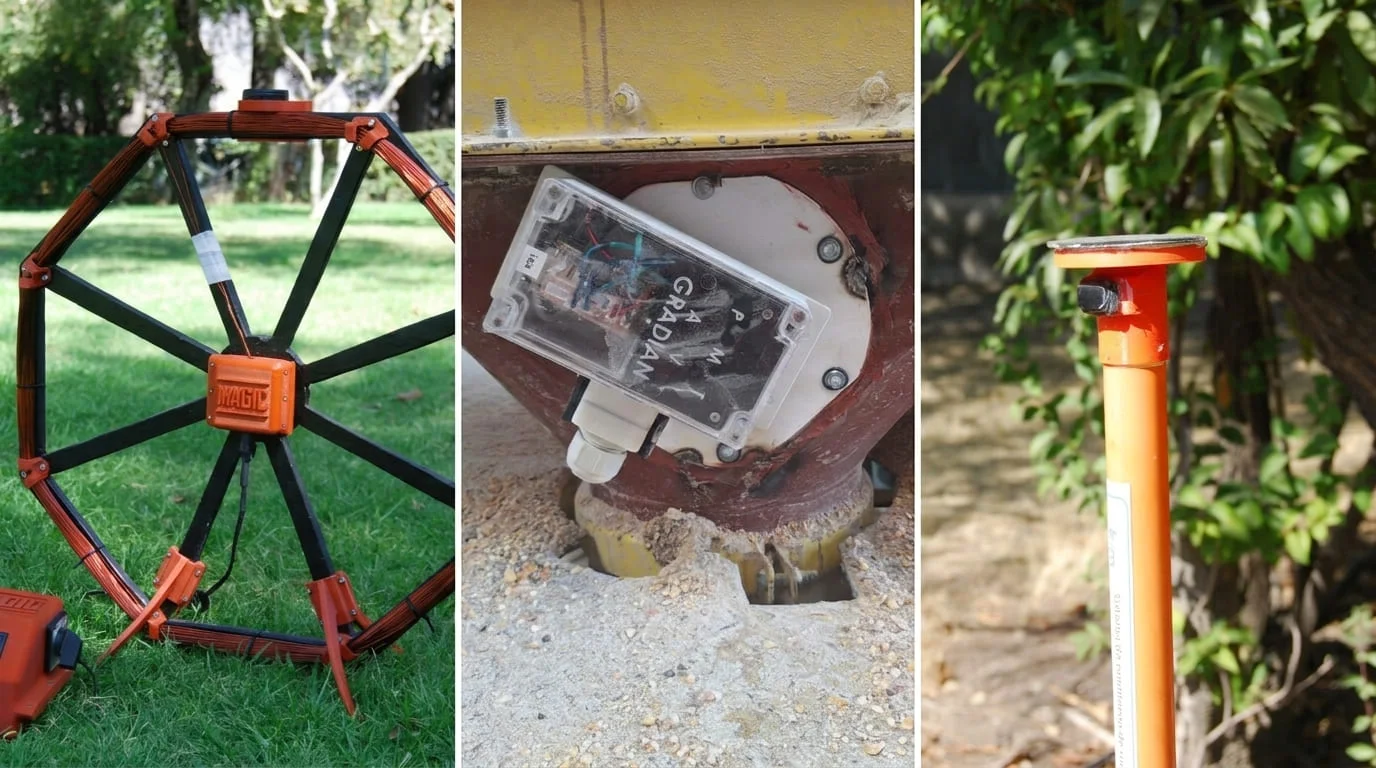 Publicado el: 09/10/2026From studying the universe to solving industry challenges: CATA’s technology transfer model in Nature Astronomy
 -
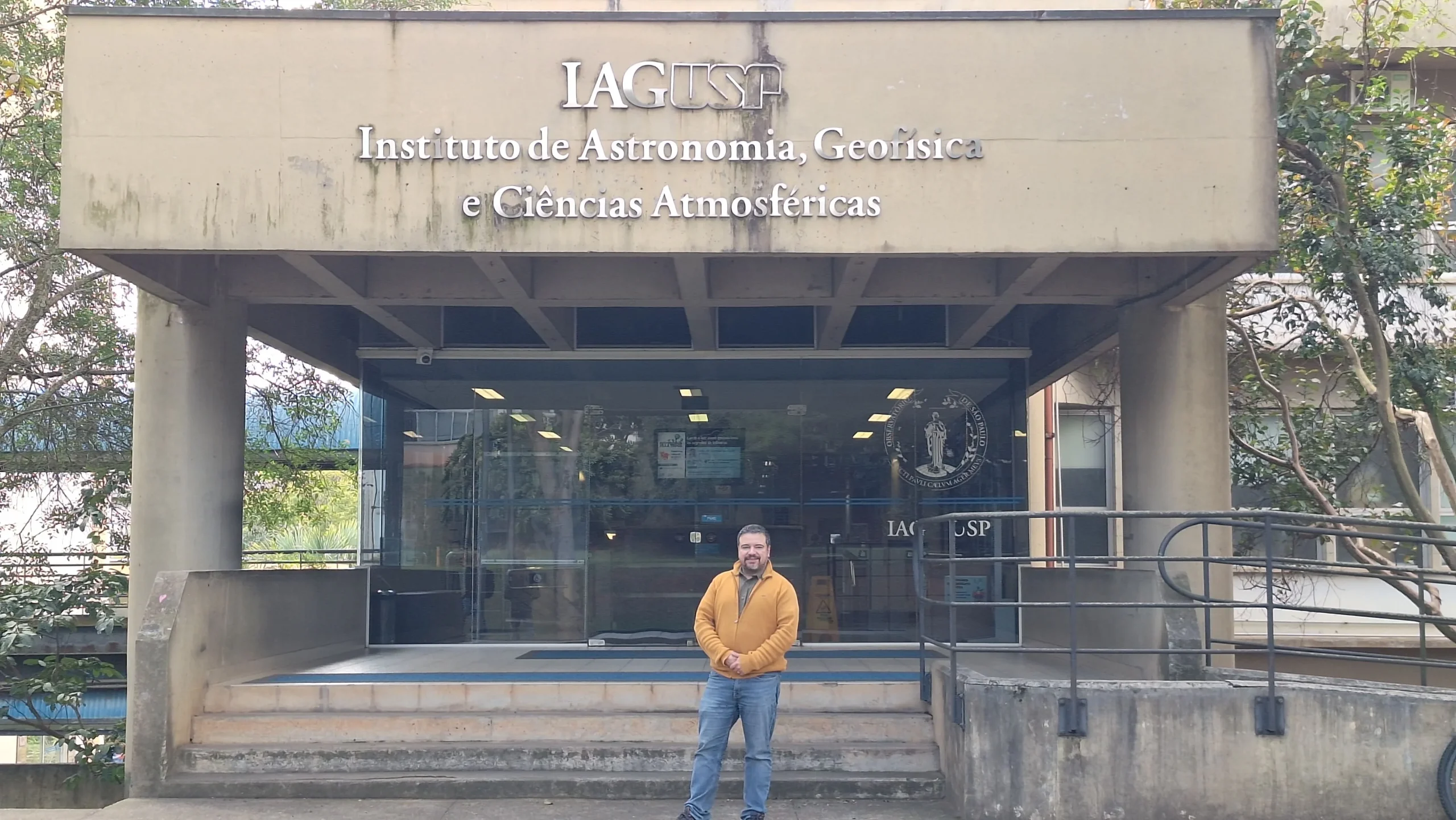 Publicado el: 01/10/2026CATA Associate Researcher concludes research stay at the University of São Paulo thanks to a Brazilian fellowship
Categories list
- Acknowledgments 29
- Astrobiology 12
- AstroCluster 1
- Black holes 21
- Corporativo 73
- Cosmology 10
- Descubrimientos 30
- Disclosure 91
- Exoplanets 19
- Extension 14
- Galaxies 29
- Galaxies formation 12
- Inter y Transdisciplina 5
- Local Universe 22
- Publications 9
- Sin categorizar 34
- Solar System 30
- Stellar formation 13
- Technology 34
- Technology Transfer 34