

ANID renews CATA’s basal finance for five years and envisions a new phase of scientific and technological development
The renewal for the 2026–2031 period recognizes the Center for Astrophysics and Associated Technologies’ track record in cutting-edge astronomical research, advanced human capital development, technology transfer, and scientific communication and outreach. In this new phase, CATA will seek to strengthen its scientific capabilities, expand collaboration with industry, and consolidate astronomy’s contribution to the country’s development.
The National Agency for Research and Development (ANID) approved the renewal of core funding for the Center for Astrophysics and Associated Technologies (CATA) for the 2026–2031 period, ensuring the continuity of its work as a center for scientific research and technological development. CATA brings together five partner universities: the Universidad de Chile, the Pontificia Universidad Católica de Chile, the Universidad de Concepción, the Universidad Diego Portales, and the Universidad Andrés Bello. It also involves researchers from other universities across the country, expanding its collaborative networks and strengthening the coordination of scientific capabilities at the national level. The decision recognizes the progress made since 2007 and supports a new phase of development aimed at deepening astronomical research, expanding innovation capabilities, and highlighting the Center’s contribution to the country’s scientific and technological development.
The renewal was approved following an evaluation process conducted by national and international experts, who analyzed the Center’s results and its proposal for continued operation. Among the aspects evaluated were scientific excellence, the training of new generations of specialists, and the ability to apply knowledge and technological developments to other fields through collaborative networks with academic institutions, public agencies, and stakeholders in the private sector.
For Patricia Tissera, Director and Principal Researcher at CATA, this decision recognizes the work carried out by the Center’s community and opens up new opportunities for its growth. “This renewal represents recognition of the scientific and technological legacy we have built as a Center, thanks to the commitment of our researchers from all universities, students, professionals, and work teams. Over the years, we have made progress in cutting-edge astronomical research, instrumentation development, and the training of new generations of scientists, while also building capabilities that today enable us to help address challenges in other sectors.”
“This new phase presents us with both the challenge and the opportunity to continue strengthening our lines of research, foster new collaborations, and expand the impact of our knowledge for the benefit of society,” she noted.
Cutting-edge astronomical research: new questions about the Universe
Scientific research is at the heart of CATA’s work. Since 2007, the Center has strengthened its capabilities to study various phenomena in the universe, expand its collaborative networks, and contribute to the advancement of astronomy from Chile, one of the world’s most important locations for astronomical observation.
During the next five-year period, CATA plans to expand its research in areas such as galaxy formation and evolution, black holes, star formation, exoplanets, and astrobiology, among other fields of contemporary astrophysics. These efforts are supported by collaboration with national and international scientific institutions and by the opportunities offered by the country’s observational infrastructure.
The development of astronomical instrumentation and specialized tools for data acquisition, processing, and analysis will continue to be a strategic component of this work. These capabilities make it possible to address increasingly complex scientific questions and generate essential tools for expanding the possibilities for observing and analyzing the Universe.
Over the next five years, the challenge will be to expand on these lines of research and take advantage of the opportunities offered by Chile’s astronomical infrastructure and international scientific networks to address new questions about the universe.
Advanced human capital development: skills for science and innovation
The development of advanced human capital is another of CATA’s pillars. By involving graduate students, postdoctoral researchers, scientists, and engineers in its activities, the Center contributes to the development of specialized capabilities for astronomical research and technological development.
This training is not limited to the academic sphere. The skills acquired in research, big data analysis, instrumentation, artificial intelligence, and the development of technological solutions also open up opportunities in productive sectors that require advanced knowledge and innovation capabilities.
As part of its strategy, CATA seeks to strengthen the link between the development of advanced human capital and the needs of the productive sector. In line with this, approximately 20% of the doctoral graduates from the Center over the past four years have joined the industry, reflecting the potential of the skills developed through scientific research to also contribute to innovation and technological development in various sectors.
Over the next five years, the institution will seek to expand opportunities for training and professional development, strengthening the skills that will enable its graduates to contribute to both scientific research and innovation in various sectors.
Technology Transfer: from the Universe to society
One of CATA’s institutional achievements has been the consolidation of a technology transfer model that seeks to link the capabilities developed in astronomy and scientific instrumentation with specific challenges facing industry and society.
Through its Technology Transfer Unit (UTT), established in 2023, the Center has strengthened mechanisms to identify technologies and knowledge with application potential, connect its research and engineering teams with external stakeholders, and explore opportunities for collaborative development. This model seeks to align the needs of the surrounding community with the Center’s scientific capabilities, fostering the advancement of initiatives from their earliest stages of development through to their eventual application.
Currently, CATA has a portfolio of 18 technologies at various stages of maturity, ranging from Technology Readiness Levels (TRL) 3 to TRL 7, with potential applications in areas such as mining, the agri-food industry, and environmental monitoring.
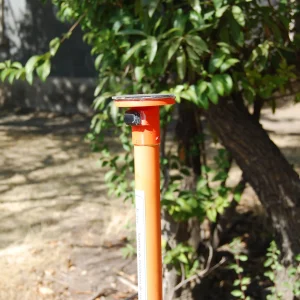
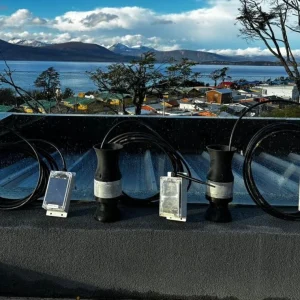
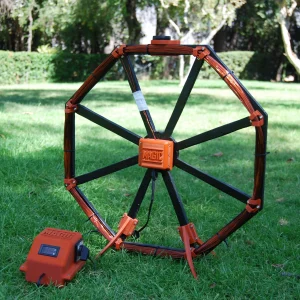
These initiatives include low-frequency communication systems for mining operations, spectroscopic techniques for grain classification, and optical instrumentation tools designed to detect red tides. These developments demonstrate how the knowledge, instruments, and methodologies used to study the universe can be adapted to meet the needs of other sectors.
The UTT’s experience has made it possible to establish mechanisms for identifying opportunities for collaboration, linking scientific capabilities with production needs, and supporting the development of technologies with practical applications.
According to Santiago Prat, General Manager of CATA, this renewal represents an opportunity to further develop this strategy and expand its scope. “This result is the fruit of the work of the entire Center community and allows us to plan for its development in the medium and long term. We have built high-level scientific and technological capabilities, and the challenge now is to consolidate our technology transfer model so that cutting-edge science and technology translate into solutions and innovation that have an impact on industry and benefit society. We want to diversify and strengthen our collaboration with the private sector and co-develop technologies that address real needs, without losing sight of the fact that astrophysics research is the foundation of everything we do,” he said.
Looking ahead to 2031, one of the challenges will be to expand opportunities for collaboration with companies and institutions, promote new research and development projects, and strengthen the technical and management capabilities needed to advance the maturation and transfer of technologies. The goal is to consolidate a model in which scientific excellence and innovation reinforce one another, thereby expanding the Center’s potential to contribute to Chile’s productive and technological development.
Science communication and outreach: bringing astronomy closer to the public
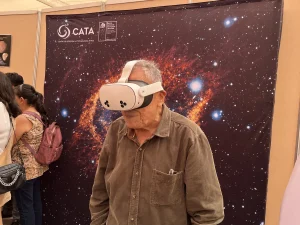
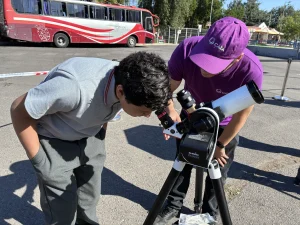
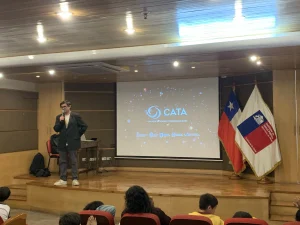
Bringing scientific knowledge to the general public is part of CATA’s mission. Through educational activities, lectures, workshops, stargazing sessions, and interactive experiences, the Center fosters an interest in astronomy and helps strengthen scientific literacy among diverse audiences.
This work has expanded to various regions of the country through initiatives carried out in collaboration with universities, educational institutions, public agencies, and local organizations. These community-based efforts help broaden access to astronomical knowledge and create opportunities for the scientific community and the general public to come together, in both urban and rural areas.
In addition to communicating scientific findings, this work helps raise awareness of the CATA community’s efforts and strengthen the public’s appreciation of astronomy.
Over the next five years, CATA will seek to expand on this work by strengthening communication of its scientific and technological advances, broadening opportunities for participation, and promoting new learning experiences and engagement with communities, also with a view to hosting the General Assembly of the International Astronomical Union (IAU) in 2030.
The vision for this area envisions an increasingly close relationship between research, communication, and citizen participation, so that the knowledge generated at the Center can reach new audiences and contribute to a society with greater opportunities to engage with science.
The renewal of core funding marks a new phase for CATA, bringing with it the challenge of further solidifying its leadership in astronomical research, strengthening the development of cutting-edge instrumentation and technologies, and expanding opportunities for scientific and productive collaboration.
Building on the capabilities developed since 2007, the Center views the 2026–2031 period as an opportunity to explore new questions about the universe, promote technological solutions, and make scientific knowledge accessible to more people. This agenda seeks to reaffirm CATA’s contribution to Chile’s scientific and technological development.

Outstanding news

Recent news
-
Publicado el: 02/11/2026ANID renews CATA’s basal finance for five years and envisions a new phase of scientific and technological development
-
 Publicado el: 19/10/2026CATA will contribute to data processing for a major international astronomy project
-
 Publicado el: 19/10/2026Study led by CATA researchers solves a 30-year-old mystery about a dwarf galaxy
-
 Publicado el: 15/10/2026Structures potentially associated with the formation of super-Earths and mini-Neptunes have been detected in compact disks
-
 Publicado el: 09/10/2026From studying the universe to solving industry challenges: CATA’s technology transfer model in Nature Astronomy
Categories list
- Acknowledgments 30
- Astrobiology 12
- AstroCluster 1
- Black holes 21
- Corporativo 74
- Cosmology 10
- Descubrimientos 30
- Disclosure 91
- Exoplanets 19
- Extension 14
- Galaxies 29
- Galaxies formation 12
- Inter y Transdisciplina 5
- Local Universe 22
- Publications 9
- Sin categorizar 34
- Solar System 30
- Stellar formation 13
- Technology 34
- Technology Transfer 34


