CATA Associate Researcher concludes research stay at the University of São Paulo thanks to a Brazilian fellowship
Ricardo Demarco spent three months at USP, funded by a grant from the Brazilian agency FAPESP, furthering his collaboration on the international S-PLUS project.
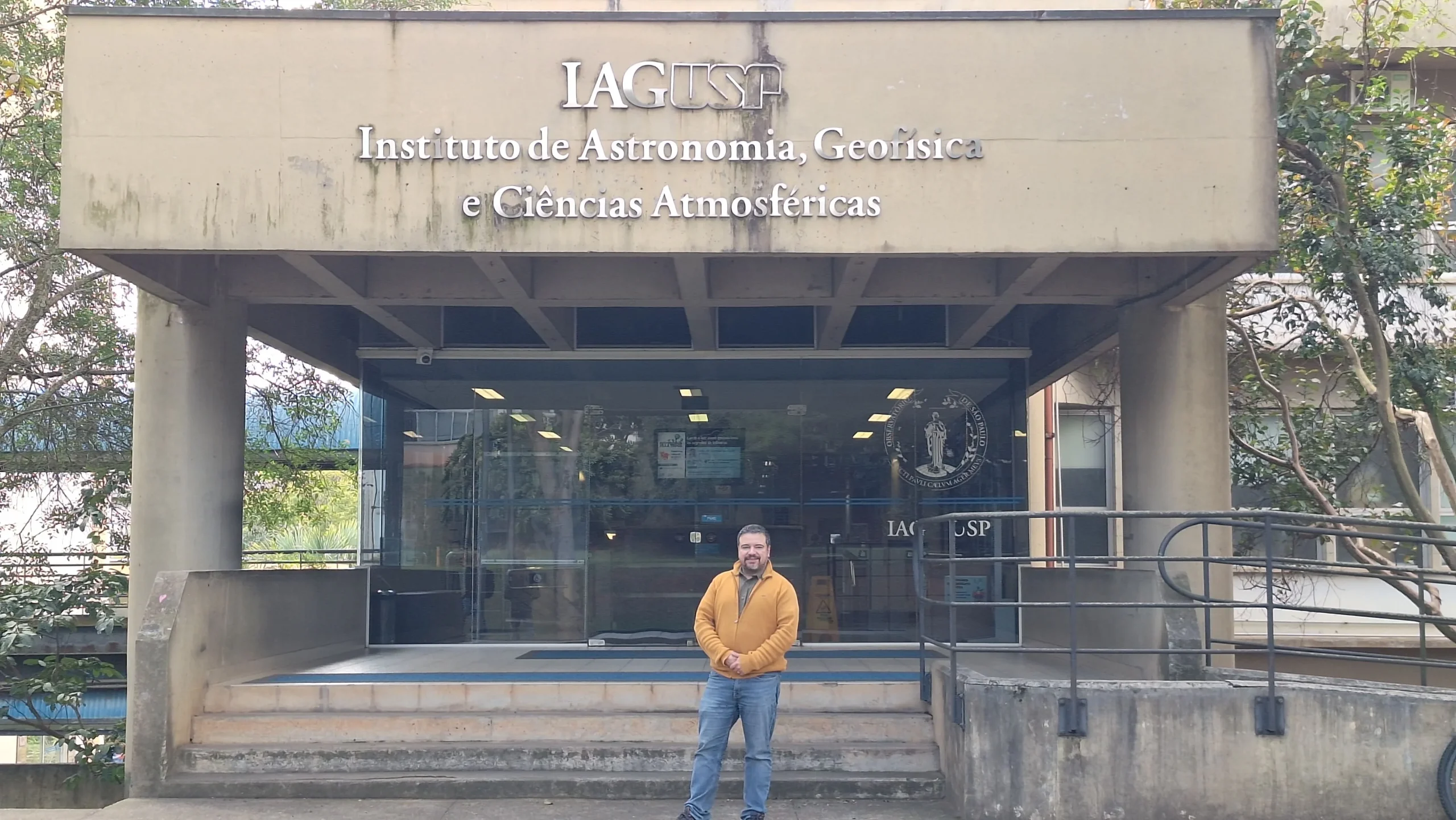
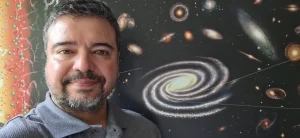
Ricardo Demarco, Associate Researcher at the Center for Astrophysics and Associated Technologies – CATA (project financed by ANID) and professor at Universidad Andrés Bello (UNAB), conducted a research stay between July and September at the Institute of Astronomy, Geophysics, and Atmospheric Sciences (IAG) at the Universidade de São Paulo (USP), thanks to a grant from the Fundação de Amparo à Pesquisa do Estado de São Paulo (FAPESP), one of Brazil’s leading scientific funding agencies.
During his stay, Demarco worked directly with researcher Claudia Mendes de Oliveira of USP’s IAG, who is the principal investigator of the international Southern Photometric Local Universe Survey (S-PLUS) project—an initiative led by USP that brings together collaborators from Argentina, Chile, and Europe.
“Through this fellowship, I came to work directly with Professor Mendes de Oliveira alongside her postdoctoral researchers and doctoral students, with whom we share the same lines of research. Working remotely—exchanging emails or holding Zoom meetings—is not the same as being in person with your colleagues and being able to have daily discussions. That strengthens collaborative ties and allows us to conduct science much more effectively and efficiently,” says Demarco.
Regarding what receiving this scholarship means, Demarco describes it as recognition of a collaboration that has developed over time: “This is my fourth consecutive year coming to Brazil to visit Professor Mendes de Oliveira. For me, it is recognition of work that we have been developing gradually—work that doesn’t happen overnight, but has been built up over the years.”
El proyecto S-PLUS utiliza un telescopio robótico de 80 centímetros instalado en el Observatorio Interamericano de The S-PLUS project uses an 80-centimeter robotic telescope installed at the Cerro Tololo Inter-American Observatory in Chile, equipped with 12 photometric bands that cover nearly 9,000 square degrees of the sky. This coverage enables the acquisition of high-precision photometric redshifts, which make it possible to identify galaxies and study larger-scale structures such as galaxy clusters, groups, and filaments in the nearby universe, as well as to characterize the physical properties of the galaxies themselves: stellar mass, stellar populations, morphology, and star formation activity.
As an Associate Researcher at CATA, Demarco’s work is directly linked to this collaboration: it focuses on the study of galaxy clusters and groups in the local universe, which serve as a fundamental benchmark for investigating the evolution of galaxies in the early universe.
“One of the central themes of CATA’s Galaxies area is to gain a thorough understanding of the properties of the galaxies that are ‘close’ to us.” “S-PLUS provides precisely that view of galaxies in clusters and allows us to make progress on central questions in current extragalactic astrophysics, such as understanding how, where, and when galaxies stop forming stars as they fall into these large structures,” explains the Center’s researcher.
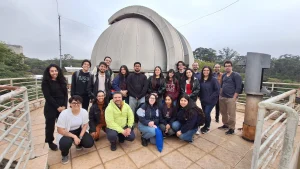
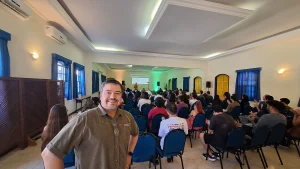
The visit also strengthened the collaboration among various researchers; as part of the annual scientific meeting of the S-PLUS project, Demarco’s postdoctoral researchers, Patricio Lagos and Alejandra Lugo—both members of CATA—participated, as did one of his students from UNAB, Amanda Huircán.
These types of visits reaffirm the value of international collaboration as a driving force behind astrophysics research, strengthening scientific networks among researchers and opening up training opportunities for students, thereby helping to answer some of the most important questions about the formation and evolution of galaxies in the universe.
Outstanding news
Recent news
-
 Publicado el: 19/10/2026CATA will contribute to data processing for a major international astronomy project
 -
 Publicado el: 19/10/2026Study led by CATA researchers solves a 30-year-old mystery about a dwarf galaxy
 -
 Publicado el: 15/10/2026Structures potentially associated with the formation of super-Earths and mini-Neptunes have been detected in compact disks
 -
 Publicado el: 09/10/2026From studying the universe to solving industry challenges: CATA’s technology transfer model in Nature Astronomy
 -
Publicado el: 01/10/2026CATA Associate Researcher concludes research stay at the University of São Paulo thanks to a Brazilian fellowship
Categories list
- Acknowledgments 29
- Astrobiology 12
- AstroCluster 1
- Black holes 21
- Corporativo 73
- Cosmology 10
- Descubrimientos 30
- Disclosure 91
- Exoplanets 19
- Extension 14
- Galaxies 29
- Galaxies formation 12
- Inter y Transdisciplina 5
- Local Universe 22
- Publications 9
- Sin categorizar 34
- Solar System 30
- Stellar formation 13
- Technology 34
- Technology Transfer 34