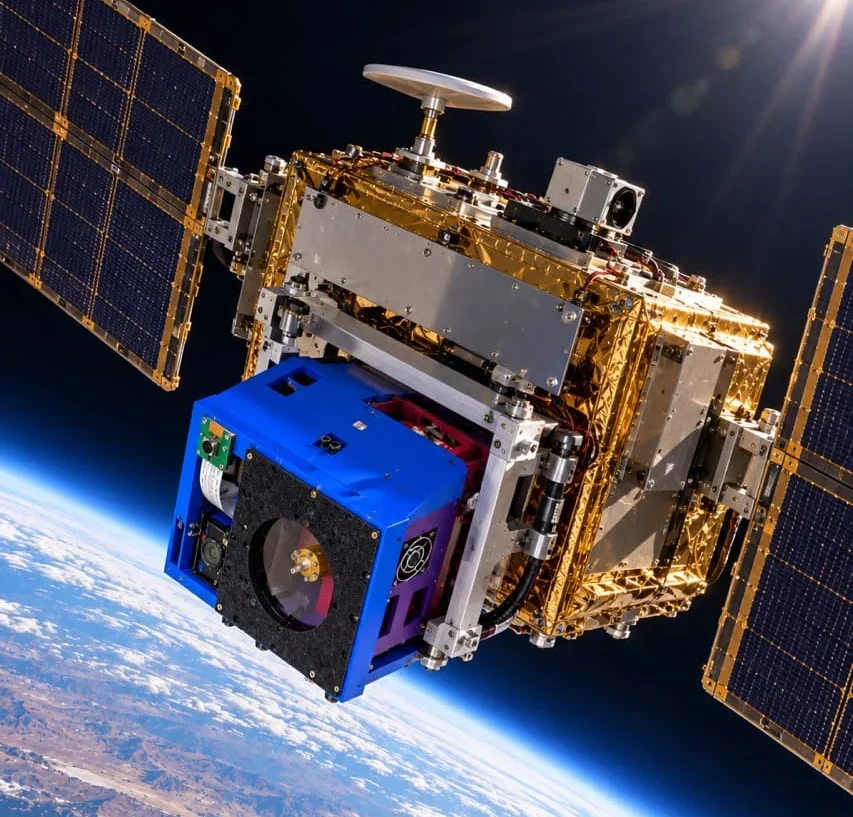
Chilean technology aims to improve the accuracy of telescopes studying the origin of the Universe
The project, led by astronomer Rolando Dünner with participation from CATA, will develop a satellite prototype to calibrate, with high precision, instruments that study the cosmic microwave background. The initiative also incorporates measures for gender equity, student training, and criteria for responsible space development.
Understanding the earliest moments of the universe requires instruments capable of detecting extremely faint signals and measuring them with great precision. In this endeavor, the calibration of telescopes that observe the Cosmic Microwave Background (CMB)—the oldest light in the universe—is fundamental to contemporary cosmology.
Observations of this radiation allow us to study the conditions of the early Universe and search for evidence of phenomena that occurred during its earliest stages. To do this, it is necessary to accurately determine the orientation of the received signals. Small deviations can affect the interpretation of the data and make it difficult to identify extremely faint phenomena. “An error of just 0.2 degrees in the polarization angle can hide or distort fundamental discoveries, such as the signature of primordial gravitational waves, which would tell us about the first moments of the Universe,” explains Rolando Dünner, Associate Researcher at the Center for Astrophysics and Associated Technologies – CATA (project financed by ANID), professor at the Pontificia Universidad Católica de Chile (UC), and Director of the UC Center for Astroengineering (AIUC).
It is within this context that HoverSat is being developed—an initiative that aims to lay the technical groundwork for a future mission capable of performing this task from orbit. The project was awarded by the National Agency for Research and Development (ANID) as part of the 2026 Technology Research Competition, where it received one of the highest scores in the call for proposals.
A satellite solution to an astronomical challenge
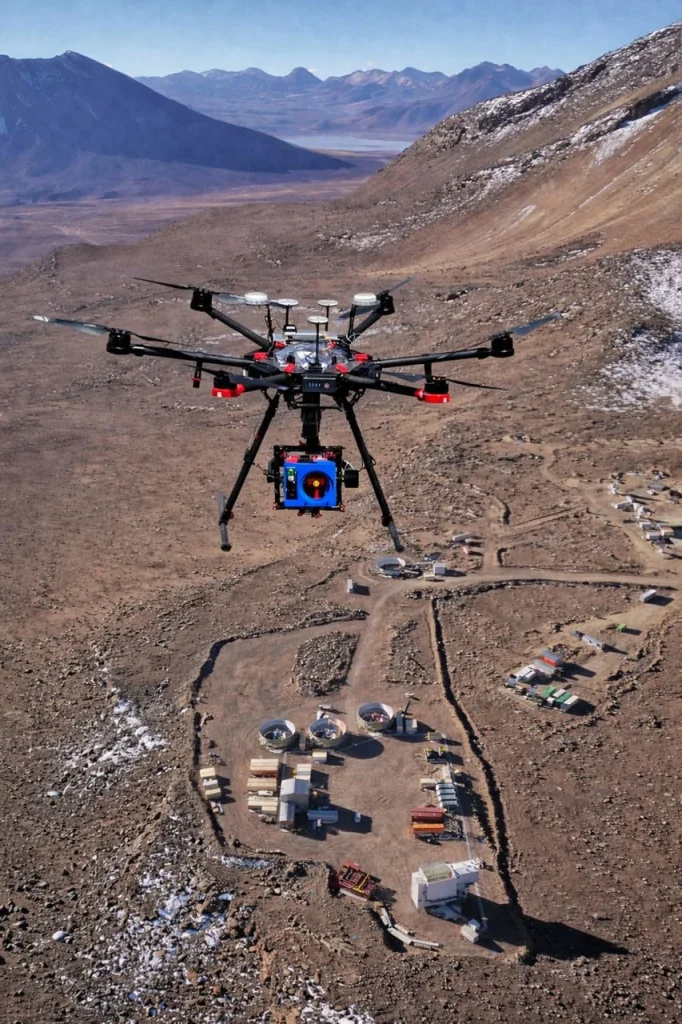
HoverSat builds on HoverCal, a previous project funded through the FONDEF program. This system uses a drone to transport a calibration source and is currently in use by the telescopes at the Simons Observatory in the Atacama Desert.
Its main limitation relates to the size of the instruments. For telescopes with a diameter of six meters or more, the light source must be located more than 40 kilometers away—a distance that exceeds a drone’s operational capabilities. “The solution is to take the light source into space. A small satellite passing over the observatories could illuminate any telescope from the correct distance, regardless of its size or location. In orbit, it is not possible to measure the source’s orientation from the ground, so HoverSat will incorporate a star camera that will calculate its absolute position based on the stars, with a target accuracy of 0.1 degrees,” the researcher notes.
During the 24-month implementation period, an integrated prototype featuring a radio frequency source, a star camera, GPS, an onboard computer, and a power system will be designed, built, and validated. It will undergo vibration and thermal testing, as well as validation campaigns at the Simons Observatory facilities.
CATA is participating as a secondary beneficiary, while the Pontificia Universidad Católica de Chile is the primary beneficiary. To this end, the Center will fund the participation of an engineer responsible for electronics and software components, whose work will be carried out at the UC Center for Astroengineering (AIUC), a laboratory affiliated with CATA.
Science and technology with a gender perspective
HoverSat includes measures designed to increase women’s participation and train specialists in fields related to astronomy, engineering, and the space sector.
The proposal will be co-led by researcher Marilyn Cruces, astronomer and professor in the UC Department of Electrical Engineering, who will serve as alternate director. Furthermore, calls for team members will explicitly encourage women to apply and will take into account career interruptions related to caregiving responsibilities. In cases of equal merit, this factor will be considered a selection criterion.
The student training program includes opportunities to work on undergraduate and graduate theses, visits to AIUC laboratories, and an open seminar on Women in Astronomy and Physics.
Chile as a developer of astronomical and space technology
For Chile, the initiative represents an opportunity to leverage the scientific and technological ecosystem built around its observatories and to advance the development of solutions related to their operation. “This means transitioning from being a country that hosts telescopes to one that develops the technology that makes them more precise. By concentrating world-class observatories in a single region, the North is the natural place to first test and adopt a satellite calibration service. The project also builds local capacity in space engineering—such as orientation metrology, payload integration, and mission design—which directly contributes to the national satellite program,” says Dünner.
Along these lines, the team will seek to establish a partnership with the National Space Center (CEN) to explore areas such as payload integration into satellite platforms, access to environmental testing infrastructure, and the design of a potential mission. “The areas of common interest are payload integration into satellite platforms, the use of their environmental testing infrastructure, and the design of the future mission. “We want HoverSat to be a candidate for flight on future demonstration missions of the Chilean satellite program,” says Dünner.
Responsible space development
From its earliest stages, the HoverSat design has taken into account aspects related to the sustainability of in-orbit activities. To this end, it will adhere to the IADC/UNOOSA international guidelines and the ISO 24113 standard, including a limited orbital lifetime and a strategy for deorbiting once the mission is complete.
The use of radio frequencies will also be subject to the regulations of the International Telecommunication Union (ITU) and the Undersecretariat of Telecommunications (SUBTEL). Frequencies will be selected to avoid interference with radioastronomy observations and Earth observation services.
Potential beneficiaries of this solution include large observatories and instruments dedicated to the study of the cosmic microwave background and millimeter astronomy, including the Simons Observatory, CLASS, CCAT, ALMA, the South Pole Telescope, BICEP/Keck, and the future CMB-S4.
By operating from orbit, the source could overcome the limitations associated with its location on Earth and be used with instruments of various sizes and in different locations. Its applications could also extend to fields such as the aerospace industry and telecommunications.
The Simons Observatory, represented in Chile by the University of California, Berkeley, will serve as the partner institution. Its participation includes providing access to its telescopes in Atacama, logistical support during validation campaigns, and independent data analysis, thereby continuing the collaboration initiated with HoverCal.
In this way, HoverSat integrates astronomy, space engineering, and the development of new capabilities to address the challenges of observing the universe.
Outstanding news
Recent news
-
 Publicado el: 19/10/2026CATA will contribute to data processing for a major international astronomy project
 -
 Publicado el: 19/10/2026Study led by CATA researchers solves a 30-year-old mystery about a dwarf galaxy
 -
 Publicado el: 15/10/2026Structures potentially associated with the formation of super-Earths and mini-Neptunes have been detected in compact disks
 -
 Publicado el: 09/10/2026From studying the universe to solving industry challenges: CATA’s technology transfer model in Nature Astronomy
 -
 Publicado el: 01/10/2026CATA Associate Researcher concludes research stay at the University of São Paulo thanks to a Brazilian fellowship
Categories list
- Acknowledgments 29
- Astrobiology 12
- AstroCluster 1
- Black holes 21
- Corporativo 73
- Cosmology 10
- Descubrimientos 30
- Disclosure 91
- Exoplanets 19
- Extension 14
- Galaxies 29
- Galaxies formation 12
- Inter y Transdisciplina 5
- Local Universe 22
- Publications 9
- Sin categorizar 34
- Solar System 30
- Stellar formation 13
- Technology 34
- Technology Transfer 34